





Résultats
41 articlesTrier
 19:43EN
 AI Engineer· 26 oct. 2026Jack Wotherspoon on Building a Team of Managed AgentsJack Wotherspoon · Google DeepMindGoogle DeepMind’s Jack Wotherspoon introduces Gemini Managed Agents: cloud sandboxes that let teams run coding and research agents with a single API call. He explains how persistent environments, reusable skills, proxy-injected credentials, schedules, and specialized agents fit together.
 20:55ENAI Engineer· 26 oct. 2026Jesse Hall: Build Voice Agents for Conversations, Not LeaderboardsJesse Hall · LiveKitLiveKit’s Jesse Hall explains how to evaluate voice agents as real-time systems: understand callers, handle interruptions, keep talking while tools run, and measure the delay people actually hear.
 18:27ENAI Engineer· 26 oct. 2026Daksh Gupta on Building a Better AI Code Review AgentDaksh Gupta · GreptileGreptile co-founder Daksh Gupta explains why a webhook plus a coding agent is not enough for reliable pull-request review—and how targeted prompts, incident data, model inversion, codebase context, browser testing, and task-specific model routing can help.
 17:56ENAI Engineer· 25 oct. 2026How Bridgewater Keeps Its AI Analyst Inside Permission BoundariesNikhil Benesch, Aaron Linsky · turbopufferAaron Linsky and Nikhil Benesch explain why search over an enterprise vault must honor document permissions without sacrificing recall or speed. Their solution combines vector indexing with native filtering to search hundreds of millions of vectors in roughly 120 milliseconds.
 35:19ENAI Engineer· 25 oct. 2026SallyAnn DeLucia: How to Write Your First AI EvalSallyAnn DeLucia · Arize AITurn an agent’s real traces into concrete pass/fail criteria, then build an LLM judge you can test, align with people, and run in production.
 20:58ENAI Engineer· 25 oct. 2026Vinoo Ganesh on Making Financial AI Cite Every NumberVinoo Ganesh · KeplerKepler CEO Vinoo Ganesh explains why financial AI should retrieve and cite figures while deterministic software handles the math. His design makes traceability, retrieval quality, and tenant security part of the answer itself.
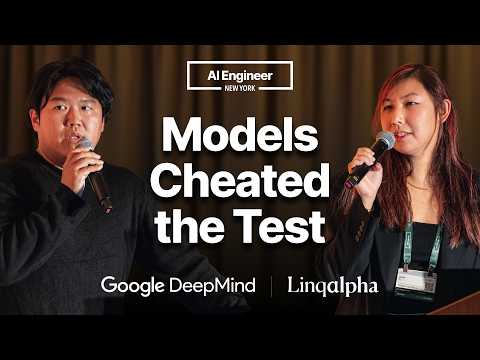 18:31ENAI Engineer· 25 oct. 2026Janie Gu and Suyeol Yun: Why Frontier Models Fail as Buy-Side AnalystsJanie Gu, Suyeol Yun · Google DeepMindJanie Gu explains why benchmark scores can mislead, while Suyeol Yun presents MandateBench, which tests whether a model can turn a fund mandate into a defensible investment memo. The two talks show why real workflows, reproducible grading, and evidence-backed reasoning matter.
 15:27ENAI Engineer· 25 oct. 2026What AI Engineers Do Now: Build the Loop Around AgentsAparna Dhinakaran · Arize AIAparna Dhinakaran argues that AI engineers are moving from shipping individual features to building systems that let agent teams improve them. At Arize, that means tracing agent behavior, evaluating its work against human judgment, and feeding those signals back into an always-on agent.
 19:37ENAI Engineer· 25 oct. 2026Jay Sahnan and Arik Bird on Building Financial Agents for the Whole WebJay Sahnan, Arik Bird · BrowserbaseBrowserbase’s Jay Sahnan and Arik Bird show how browser agents reach financial data hidden behind logins and bot defenses. Their Ramp, Bill, and Stripe examples connect reliable cloud browsers with Stagehand’s more adaptive controls.
 1:50:48EN
 Y Combinator· 24 oct. 2026Why Inference Matters 12× More Than TrainingFrançois Chaubard, Dan Fu, Jeff Morgan, Joe Fioti, Liangsheng Yin · Y CombinatorYC Paper Club walks the inference stack from an API request down to GPU kernels. Four talks from Together AI, Ollama, Luminal, and SGLang argue that serving quality, not just training FLOPs, is where most of the compute and the money now sit.
 34:11EN
 GOTO Conferences· 23 oct. 2026Anatoliy Bilenko and Alberto Carretero: Making Database Protocols Reliable with Formal Methods and AIAnatoliy Bilenko, Alberto Carretero · CanonicalCanonical’s database engineers connect executable specifications, model-based tests, failure exploration, and reconstructed execution histories—and explain why none of these techniques proves a real system correct on its own.
 17:42ENAI Engineer· 21 oct. 2026Is a Faster Model Actually Faster? Measure the Finished Job, Not the TokensMorgan Suo · MiniMaxMiniMax's Morgan Suo takes the engineering changes inside M3.1 Flash one by one and asks the question that matters to users: does the job an analyst needs actually get done sooner, cheaper and correctly?
 56:49EN
 Stanford AI Club· 15 oct. 2026Alfred Lin on Building in the AI Era: The Diffusion Gap, Founder Conviction, and Fire and IceAlfred Lin, Jason Zhang, Tanvir Bhathal · Sequoia CapitalAt Stanford AI Club, Sequoia’s Alfred Lin explains where he sees opportunity in AI and why learning, human understanding, and operating discipline still shape enduring companies.
 12:49EN
 OpenAI· 7 oct. 2026Alex Mashrabov: Higgsfield agents that choose models and launch their own GPUsAlex Mashrabov · HiggsfieldAt OpenAI DevDay 2026, Higgsfield's CEO walks through why a continuous media experience needs an agent that picks models, scores its own output, and provisions GPUs — including a live 10-hour AI stream small teams can now ship.
 13:12ENOpenAI· 7 oct. 2026Alexandra Lato on Building Stack Overflow for Agents and Stack Internal with CodexAarti Bagul, Alexandra Lato · OpenAIStack Overflow’s VP of Product explains how a small team used Codex with opposite constraints on two products—and why agent-native design means letting agents contribute knowledge, not just read it.
 38:10EN
 Google DeepMind· 1 oct. 2026From deepfakes to DNA: how SynthID watermarks AIHannah Fry, Pushmeet Kohli, Jeremy Ratcliffe · Google DeepMindHannah Fry sits down with Pushmeet Kohli and Jeremy Ratcliffe to explain SynthID: a mathematical watermark now used on text, images and video, and being extended to protein sequences so DNA synthesis companies can tell AI-designed molecules from nature.
 15:48EN
Inside Jane Street’s Texas AI Data CenterDwarkesh Patel, Yaron Minsky, Daniel Pontecorvo · Dwarkesh PatelDwarkesh Patel tours a 4,032-GPU training facility with Ron Minsky and Dan Pontecorvo, examining liquid cooling, power distribution and operational safeguards.
 1:12:58EN
Chris Lattner on Mojo and the Search for Portable GPU PerformanceYaron Minsky, Chris Lattner · Jane StreetRon Minsky and Chris Lattner discuss the language and compiler design behind Modular’s effort to make accelerator programming both portable and fast.
 58:47EN
Daniel Pontecorvo on Cooling Trading Infrastructure and WorkspacesYaron Minsky, Daniel Pontecorvo · Jane StreetFrom dense GPU racks to movable desks, Jane Street’s physical engineering team designs around heat, power, failure and human comfort.
 1:03:21EN
Horace He on Building ML Systems for Trillion-Trillion OperationsHorace He · MetaHow GPU bottlenecks, compiler design and distributed parallelism shape the systems behind large-scale model training.
 2:50EN
Inside Jane Street’s 2024 Internship ProgramInterns and staff describe an 11-week program built around learning, collaboration and hands-on projects across several disciplines.
 53:51EN
Liora Friedberg on Solving Puzzles in ProductionYaron Minsky, Liora Friedberg · Jane StreetProduction engineering combines live incident response with software, process improvements and a culture that helps people learn from mistakes. Liora Friedberg and Ron Minsky explore the work at Jane Street.
 9:14EN
OCaml Local Function Types: Why Partial Application Can EscapeRichard Eisenberg · Jane StreetRichard Eisenberg uses a list-append example to show how a local argument changes the mode of a partially applied function in Jane Street’s OCaml compiler branch.
 23:25EN
Richard Eisenberg: How OCaml Locals Reduce Garbage-Collected AllocationRichard Eisenberg · Jane StreetAn annotated list-processing example shows why locality must be preserved both when values are created and when functions consume them.
Charger plus24 sur 41 affichés