







Résultats
54 articlesTrier
 1:05:45EN
Cyrus Omar on Live Programming and a Computational Commons for Humans and AICyrus OmarA demonstration of Hazel shows how immediate feedback, structured collaboration and carefully scoped permissions could support people and AI agents working together.
 1:34:36EN
Nate Foster: Treating the Network as a ProgramYaron Minsky, Nate Foster · Jane StreetFrom programmable switches to BGP, a programming-languages researcher explains how higher-level policies and formal models can make networks easier to change.
 46:35EN
Jon Gjengset on the Cost of Concurrency CoordinationJon GjengsetWhy shared cache lines can make even read-heavy locks slow, and how a different data structure trades writer work for scalable reads.
 1:00:15EN
Arjun Guha on How Language Models Represent Code and How People Prompt ThemArjun Guha · Northeastern UniversityExperiments with activation steering and student-written prompts reveal how programming models behave—and why evaluating them requires more than a single benchmark score.
 52:05EN
Corwin de Zahr: Exploring OCaml Runtime Safety Through a CTF ChallengeCorwin de Zahr · Jane StreetA deliberately restricted OCaml sandbox becomes a way to examine type safety, callbacks, memory representation and binary debugging.
 1:12:58EN
Chris Lattner on Mojo and the Search for Portable GPU PerformanceYaron Minsky, Chris Lattner · Jane StreetRon Minsky and Chris Lattner discuss the language and compiler design behind Modular’s effort to make accelerator programming both portable and fast.
 1:01:23EN
Will Crichton on Making Rust More UnderstandableWill Crichton · Brown UniversityOwnership visualizations, interactive trait diagnostics and program slicing illustrate an evidence-based approach to developer tools.
 1:27:41EN
Ron Minsky on the Saga of Multicore OCaml at Jane StreetRon Minsky · Jane StreetA production migration exposed garbage-collector regressions, led to a new pacing design, and illustrated the difficulty of turning research into reliable infrastructure.
 1:19:40EN
Ian Henry on Building Trader Tools, Functional UIs and Creative CodingRon Minsky, Ian Henry · Jane StreetFrom high-density options interfaces to a 3D playground, Ian Henry and Ron Minsky explore the software choices that make complex tools usable.
 47:08EN
Chris Casinghino on Making OCaml Safe for Performance EngineeringChris Casinghino · Jane StreetJane Street’s OCaml extensions use layouts and modes to offer more control over memory and parallelism while preserving safety and familiar programming patterns.
 1:03:21EN
Horace He on Building ML Systems for Trillion-Trillion OperationsHorace He · MetaHow GPU bottlenecks, compiler design and distributed parallelism shape the systems behind large-scale model training.
 40:33EN
Charlie Marsh on uv: Python Dependency Resolution and PerformanceCharlie Marsh · AstralThe Astral founder explains universal lockfiles, Python packaging constraints, and the data structures and cache design behind uv.
 9:25EN
Richard Eisenberg: Using OCaml’s Coercion OperatorRichard Eisenberg · Jane StreetA practical tour of subtyping, polymorphic variants and private type abbreviations, with no runtime conversion cost.
 8:06EN
How OCaml's Proposed Include Functor Syntax Reduces RepetitionA reverse-array example shows how to derive common module functions from a minimal implementation without an extra wrapper module.
 11:28EN
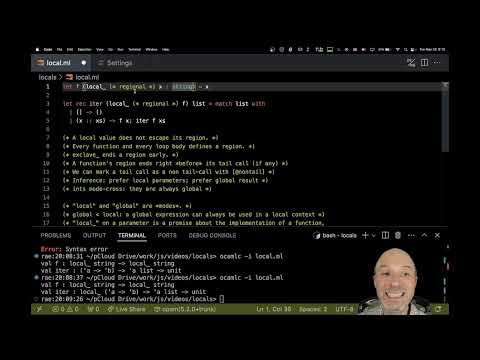
OCaml Local Types: Regional Parameters and Loop RegionsA demonstration explains why some local parameters can cross a function boundary and how loop regions reclaim allocations.
 9:14EN
OCaml Local Function Types: Why Partial Application Can EscapeRichard Eisenberg · Jane StreetRichard Eisenberg uses a list-append example to show how a local argument changes the mode of a partially applied function in Jane Street’s OCaml compiler branch.
 15:59EN
Tail Calls and Local Regions in OCamlA list-counting example reveals why a local closure can escape at a tail call, and how regional mode and [@nontail] affect the result.
 3:30EN
Richard Eisenberg on Jane Street's OCaml ExperimentsRichard Eisenberg · Jane StreetJane Street's compiler team is exploring unboxed types, locality modes, and data-race-free parallelism to make OCaml's performance and memory management better suited to its needs.
 11:07EN
How OCaml Locals Use a Separate StackA list example shows how region-scoped local values can avoid repeated garbage-collected allocations.
 23:25EN
Richard Eisenberg: How OCaml Locals Reduce Garbage-Collected AllocationRichard Eisenberg · Jane StreetAn annotated list-processing example shows why locality must be preserved both when values are created and when functions consume them.
 22:27EN
How OCaml Infers LocalityA look at local and global mode inference, module signatures, mode crossing for integers, and conversions between function types.
 15:17EN
OCaml Locals, Modes, and SubmodingA worked explanation of how local and global modes control escaping values, and how those modes interact with function types.
 12:52EN
OCaml Local Variables, Return Values and RegionsA worked example shows how `local_` and `exclave_` let a function accept a local value and return a local structure in its caller's region.
 8:52EN
Introducing Local Parameters in OCamlA demonstration of how Jane Street's experimental local mode restricts escaping values and makes function interfaces easier to reason about.
Charger plus24 sur 54 affichés