









Resultados
15 artículosOrdenar
 2:59:44EN
 Cognitive Revolution "How AI Changes Everything"· 3 jun 2026PódcastTwo Endangered Languages Broke Transformers. Nested Learning Gave Models a Sleep Button.Presenta: Nathan LabenzGoogle researcher Ali Behrouz tells Nathan Labenz how stacking update frequencies — not just layers — and an offline sleep phase could give language models genuine continual learning.
 1:13:23ENCognitive Revolution "How AI Changes Everything"· 12 oct 2024PódcastAn AI Found a GABA-Cancer Link. The Next Step Is Talking to the Cells.Presenta: Nathan LabenzMichael Levin and Leo Pio Lopez on a multilayer embedding that predicted melanoma, a cancer with no mutations, and why biology's real interface is cognitive.
 1:59:47ENCognitive Revolution "How AI Changes Everything"· 5 oct 2024PódcastBCI Would Take 30 Years. This Studio Pivoted to Alignment InsteadPresenta: Nathan LabenzJudd Rosenblatt and Mike Vaiana of AE Studio describe two biologically inspired results that do not need interpretability breakthroughs to work.
 1:29:14ENCognitive Revolution "How AI Changes Everything"· 29 abr 2024Pódcast55% of People Have Had a Lucid Dream. Prophetic AI Wants the Rest to Have One Every NightPresenta: Nathan LabenzProphetic AI co-founders Eric Wollberg and Wesley Berry tell Ate-a-Pi how a headband of EEG and focused ultrasound, steered by a neural transformer, is meant to light up the prefrontal cortex during REM.
 2:09:50ENCognitive Revolution "How AI Changes Everything"· 26 abr 2024PódcastHe stayed up all night playing Civilization 6 with his mindPresenta: Nathan LabenzDean W. Ball surveys EEG, ultrasound stimulation, and Neuralink with Nathan Labenz, and argues that merging with machines started decades ago.
 1:34:11ENCognitive Revolution "How AI Changes Everything"· 17 abr 2024PódcastFrom forty hours in a scanner to one: reconstructing what you see from a shared brain spacePresenta: Nathan LabenzPaul Scotti explains how MindEye2 maps a new person's fMRI into CLIP with an hour of data, and why a linear layer plus better image generators changed the cost of reading minds.
 1:25:09ENCognitive Revolution "How AI Changes Everything"· 9 feb 2024PódcastTwo-Headed Worms, Regenerated Legs, and a Sort That Learned to WaitPresenta: Nathan LabenzTufts biologist Michael Levin tells Cognitive Revolution why anatomy is rewritable software, and why he stopped a paper that might have made AI more alive.
 1:58:43ENCognitive Revolution "How AI Changes Everything"· 7 feb 2024PódcastA Worm With 302 Neurons Already Makes Trade-offs. AI Is Still on the Same Ladder.Presenta: Nathan LabenzMax Bennett maps 600 million years of brain evolution onto five breakthroughs — and asks which rungs today's models have actually reached.
 1:18:18ENCognitive Revolution "How AI Changes Everything"· 20 jun 2023PódcastFifteen Thousand Brain Numbers Were Enough to Reconstruct What Someone SawPresenta: Nathan LabenzTanishq Mathew Abraham walks through MindEye, the fMRI-to-image system that maps a handful of voxel values onto CLIP and diffusion models.
 45:31EN
 Lex Fridman· 1 jul 2020PódcastYou Are Your Own Existence Proof: Karl Friston on Free Energy, Life, and Self-AwarenessPresenta: Lex FridmanKarl Friston explains how the free energy principle reframes existence, life, planning, and self-awareness as inference problems.
 25:06ENLex FridmanPódcastLiving Inside the Brain's Story: Joscha Bach on Simulation, Self and ConsciousnessPresenta: Lex FridmanIn a clip from his conversation with Lex Fridman, Joscha Bach argues that consciousness, identity and even God are software-like patterns, and that we exist inside a narrative our brain generates.
 11:51ENLex FridmanPódcastBuilding a Brain: Paola Arlotta on the Choreography of Human Brain DevelopmentPresenta: Lex FridmanA Harvard stem cell biologist walks through how the embryo builds the cerebral cortex, why order and environment matter, and why development continues into our twenties.
 15:41ENLex FridmanPódcastAbolishing Involuntary Death: Ben Goertzel on Immortality, Pain and the Meaning of LifePresenta: Lex FridmanIn a clip from Lex Fridman's podcast, AI researcher Ben Goertzel argues that death and pain should be optional, and sketches what it would take to fund a serious attack on aging.
 11:26ENLex FridmanPódcastThe Cookie Your Brain Bakes: Joscha Bach on Happiness, Cells and the Meaning of GodPresenta: Lex FridmanIn a short clip, Joscha Bach moves from why happiness is not the point to the cell as a cosmic probe and a naturalistic reading of God as civilization.
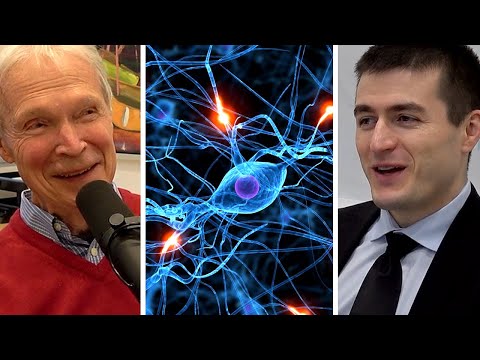 20:50ENLex FridmanPódcastGlitches as Features: What John Hopfield Says Artificial Neural Networks Are MissingPresenta: Lex FridmanIn a short conversation with Lex Fridman, physicist and neural-network pioneer John Hopfield compares evolved brains with today's artificial networks and explains why he expects AI to borrow from biology generation after generation.