








Resultados
208 artículosOrdenar
 2:51:18EN
 Zhang Xiaojun Podcast· 15 oct 2026Pódcast · 2 vocesLindon Gao on Building Dyna Robotics and Finding a Path Through the FogInvitado: Lindon Gao · Presenta: 张小珺Dyna Robotics CEO Lindon Gao explains why his company builds intelligence through real workflows, how hardware and research must evolve together, and how a founder can find clarity by letting go of the need to be right.
 1:08:02EN
 Sequoia Capital· 13 oct 2026PódcastAlphaGo Took Two Years. AlphaZero Took Hours. Silver Is Making the Same Bet on SuperintelligenceDavid Silver and Lasse Espeholt left DeepMind to build Ineffable Intelligence, a twenty-person lab that wants a superlearner to discover science, math, and language from experience rather than from a pre-training run.
 56:31EN
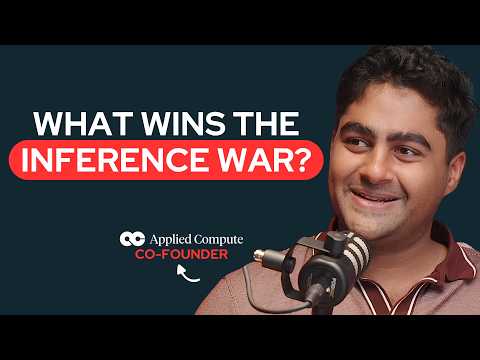
 Unsupervised Learning: With Jacob Effron· 6 oct 2026PódcastPost-Training Wins Inference: Why Owning the Weights Beats Betting on One LabPresenta: Jacob EffronApplied Compute CEO Yash Patil argues that control, private evals, and post-training on the biggest workloads matter more than fearing that frontier labs will turn malicious.
 38:14EN
 No Priors: AI, Machine Learning, Tech, & Startups· 18 sept 2026Pódcast · 2 vocesDiffusion Will Win Inference: Stefano Ermon Bets Parallel Tokens Beat Custom SiliconPresenta: Sarah Guo, Elad GilThe Stanford diffusion pioneer tells No Priors why a 50-person lab is training language models that generate many tokens at once — and why that maps to GPUs the way transformers once mapped to training.
 1:16:29EN
 Jane Street· 26 ago 2026Grant Sanderson and Alok Puranik: Positional Encodings Through Group TheoryGrant Sanderson, Alok Puranik · 3Blue1BrownStarting with assumptions about attention, they derive matrix exponentials and connect rotations, decay and Jordan blocks to RoPE and ALiBi.
 1:56:40EN
 Cognitive Revolution "How AI Changes Everything"· 8 ago 2026PódcastThe Periodic Table Was Already in the WeightsPresenta: Nathan LabenzGoodfire CTO Dan Balsam tells Nathan Labenz how concept manifolds, predictive data debugging, and a $1,000-a-month research agent are turning interpretability into a product.
 47:22ENSequoia Capital· 4 ago 2026PódcastFrom One in a Thousand to 15 Percent: Chai Discovery Treats Drug Design as a Scaling ProblemJoshua Meier and Matthew McPartlon tell Sequoia’s Training Data why antibody design is an engineering problem, not a bespoke science, and why they sell a molecular CAD suite instead of their own drugs.
 49:12ENSequoia Capital· 29 jul 2026PódcastThe People Writing the Transformer’s Eulogy Want a Lab That Can Take Vacation Without Themo1’s reasoning lead and a Gemini pre-training lead argue the architecture, not more scale, is now the bottleneck — and that replacing it starts with automating kernel generation.
 2:59:03ENZhang Xiaojun Podcast· 28 jul 2026Pódcast · 2 vocesYou Kaichao on How vLLM Grew from Open-Source Project to AI Infrastructure CompanyInvitado: You Kaichao · Presenta: 张小珺Inferact co-founder You Kaichao traces vLLM’s path from Berkeley research to a company, then explains why model, inference, hardware and agent design increasingly have to move together.
 3:46:12ENZhang Xiaojun Podcast· 16 jul 2026Pódcast · 2 vocesKay Ke on Physical Intelligence, Robot Learning, and the Future of RoboticsInvitado: Kay Ke · Presenta: 张小珺Physical Intelligence researcher Kay Ke traces the field's research lineages and explains Pi's progression from π₀ to π*₀.₆. She also reflects on education, fiction, ambition, and what it means to build robots that work beyond a demo.
 2:06:41ENCognitive Revolution "How AI Changes Everything"· 9 jul 2026PódcastZero the J-Space and a Model's Hidden Goal Lights Up on Token OnePresenta: Nathan LabenzA weekly Cognitive Revolution cut of Anthropic's global-workspace paper, AI superforecasters, open video world models, and a chip that treats inference as data movement.
 50:57ENUnsupervised Learning: With Jacob Effron· 9 jul 2026PódcastA Trillion Dollars of GPUs Will Be Worth $100 Billion in Five Years, Says LSTM's Jürgen SchmidhuberPresenta: Jacob EffronThe AI pioneer tells Unsupervised Learning's Jacob Effron why he is wildly optimistic about the technology and deeply pessimistic about the model companies buying the chips.
 1:47:38ENCognitive Revolution "How AI Changes Everything"· 4 jul 2026Pódcast19 Neurons Can Drive a Car. Liquid AI Wants Foundation Models on Every ChipPresenta: Nathan LabenzRamin Hasani traces liquid neural networks from a worm's 300-cell brain to a 600-megabyte model that will talk from inside a Mercedes, and explains why architecture search now beats architecture avengers.
 2:59:44ENCognitive Revolution "How AI Changes Everything"· 3 jun 2026PódcastTwo Endangered Languages Broke Transformers. Nested Learning Gave Models a Sleep Button.Presenta: Nathan LabenzGoogle researcher Ali Behrouz tells Nathan Labenz how stacking update frequencies — not just layers — and an offline sleep phase could give language models genuine continual learning.
 1:13:33ENUnsupervised Learning: With Jacob Effron· 3 jun 2026PódcastA Trillion Tokens Later, the Concept Finally Lands: Łukasz Kaiser on What Transformers Still MissPresenta: Jacob EffronThe Attention Is All You Need co-author tells Unsupervised Learning that transformers will probably keep winning — and that they still do not learn the way people do.
 59:41ENUnsupervised Learning: With Jacob Effron· 22 may 2026PódcastThe GPT moment for video hasn’t arrived, but AGI may already be herePresenta: Jacob EffronA day after Google I/O 2026, Gemini co-lead Oriol Vinyals argues that world models, file-system memory, and infinite-complexity RL environments will define the next era of frontier models.
 1:21:56ENUnsupervised Learning: With Jacob Effron· 15 may 2026PódcastYann LeCun Left Meta Because LLMs Will Not Get You to IntelligencePresenta: Jacob EffronThe Turing Award winner tells Jacob Effron why he spun AMI Labs out of Meta, why JEPA-style world models beat pixel generators, and why he thinks Hinton changed his mind in 2023.
 1:48:43ENCognitive Revolution "How AI Changes Everything"· 1 may 2026PódcastThe reward jumped from 3 to 180. Every Hacker News title was a Google layoff.Presenta: Nathan LabenzCoreWeave's Kyle Corbitt walks Nathan Labenz through GRPO, rubrics, RL environments, and why most reward hacks are easy to catch once you know to look.
 58:46ENUnsupervised Learning: With Jacob Effron· 9 abr 2026PódcastTwo Dates from OpenAI's Chief Scientist: Intern by September, Automated Researcher by 2028Presenta: Jacob EffronJakub Pachocki tells Jacob Effron why those timelines still hold, why continual learning is not a detour, and why showing chain of thought in the product would train the monitor away.
 1:49:53ENCognitive Revolution "How AI Changes Everything"· 5 mar 2026PódcastDon't Fight Backprop: Goodfire's Bet on Designing What Models LearnPresenta: Nathan LabenzDan Balsam and Tom McGrath return to The Cognitive Revolution with a $150 million Series B, a new research pillar called intentional design, and a rule for anyone who wants to steer training: stop trying to out-muscle gradient descent.
 1:34:29ENCognitive Revolution "How AI Changes Everything"· 18 feb 2026PódcastThree IMO Golds Missed the Same Problem. Harmonic Wants Math to CompilePresenta: Nathan LabenzVlad Tenev and Tudor Achim built Aristotle to emit Lean proofs a kernel can check—and they argue that is how mathematical superintelligence stays trustworthy.
 1:04:51ENCognitive Revolution "How AI Changes Everything"· 1 feb 2026Pódcast125 million cells took a decade. The next billion takes monthsPresenta: Nathan LabenzMark Zuckerberg and Priscilla Chan on pairing a frontier biology lab with a frontier AI lab so models train on data that was designed for them.
 4:25:13EN
 Lex Fridman· 31 ene 2026PódcastThe Architecture Barely Changed. Data, Cost, and Open Weights Did.Presenta: Lex FridmanNathan Lambert and Sebastian Raschka walk Lex Fridman through a year in which training methods and datasets moved more than model design, and 2026 looks like a fight over inference cost, agents, and who owns truly open models.
 1:03:00ENUnsupervised Learning: With Jacob Effron· 29 ene 2026PódcastA Model That Solves New Math Problems Every Week Still Isn't AGIPresenta: Jacob EffronFormer OpenAI research VP Jerry Tworek on why scaling still works, why models go hopeless when they fail, and why he left to chase continual learning.
Cargar másMostrando 24 de 208