








Resultados
347 artículosOrdenar
 1:07:35EN
 Lex FridmanPódcastWhy AI Will Never Be Perfect: Lex Fridman's Case for Keeping Humans in the LoopPresenta: Lex FridmanIn MIT 6.S093's opening lecture, Lex Fridman lays out five research areas of human-centered AI, from machine teaching to arguing machines that flag their own uncertainty.
 10:16ENLex FridmanPódcast · 2 vocesReasoning Without Logic: Yann LeCun on Teaching Neural Networks to ThinkInvitado: Yann Lecun · Presenta: Lex FridmanYann LeCun explains why he believes neural networks can reason, and what memory, recurrence and continuous representations would need to look like.
 1:24:01EN
 Lenny's PodcastPódcastFrom Sandwich Math to Expert Data: Scale AI's CEO on What Actually Makes Models SmarterPresenta: Lenny RachitskyJason Droege explains what really happened with Meta's investment in Scale AI, how data labeling turned into expert work, and what Uber Eats taught him about building businesses.
 16:41ENLex FridmanPódcastAlphaFold 2 and the Protein-Folding Breakthrough: Why Lex Fridman Calls It a Landmark for AI and BiologyPresenta: Lex FridmanA quick explainer on DeepMind's CASP14 result, how protein folding works, how AlphaFold 1 and 2 likely differ, and what the advance could unlock.
 23:54EN
 No Priors: AI, Machine Learning, Tech, & StartupsPódcast · 2 vocesBeyond GPT-7: The Customization Toolkit, Meta's Open Source Bet and the Return of Consumer AIPresenta: Sarah Guo, Elad GilIn a host-only episode, the No Priors hosts map the six levers for 10x to 100x better AI, explain fine-tuning, RAG and AI feedback, and ask why consumer social is suddenly interesting again.
 1:19:52ENLex FridmanPódcastFrom Pixels to Steering Wheels: Convolutional Networks and End-to-End DrivingPresenta: Lex FridmanLex Fridman's MIT 6.S094 lecture explains how convolutional neural networks work, where deep learning helps a self-driving car, and how to train a network to steer from video.
 57:21EN
 Cognitive Revolution "How AI Changes Everything"PódcastGemini 2.0 Flash Goes to Production: Pricing, Model Lineup and What Developers Should Build NextPresenta: Nathan LabenzGoogle DeepMind's Logan Kilpatrick walks through launch-day Gemini 2.0 releases, rate limits, model naming, and where he sees startup opportunities.
 1:27:30ENLex FridmanPódcastFrom NAND Gates to Self-Driving Traffic: Deep Reinforcement Learning in One LecturePresenta: Lex FridmanLex Fridman's second MIT 6.S094 lecture walks from the humble perceptron to deep Q-learning and the browser-based DeepTraffic competition.
 1:05:15ENLex FridmanPódcastTaming the Long Tail: How Waymo Builds a Self-Driving FactoryPresenta: Lex FridmanWaymo principal scientist Drago Anguelov explains how machine learning infrastructure, hybrid design and smart simulated agents tackle the rare events of autonomous driving.
 1:27:15ENLex FridmanPódcastPolicy Gradients vs. Q-Learning: John Schulman's Field Guide to Deep Reinforcement LearningPresenta: Lex FridmanOpenAI's John Schulman walks through the core methods of deep RL, from the score function estimator to TRPO and DQN, and says when each one is worth using.
 1:19:21ENLex FridmanPódcastVapnik's Case for Learning by Predicates, Not Just by More DataPresenta: Lex FridmanIn an MIT lecture, Vladimir Vapnik argues that complete statistical learning needs two mechanisms, data and invariants, and that choosing smart predicates is where intelligence lives.
 1:03:25ENLex FridmanPódcastTheano in an Hour: Symbolic Graphs, Automatic Gradients and a Compiler That Rewrites Your MathPresenta: Lex FridmanPascal Lamblin of MILA walks through how Theano builds, differentiates, optimizes and runs computation graphs, then trains logistic regression, a convnet and an LSTM.
 1:08:06ENLex FridmanPódcast · 2 vocesDeep Learning in One Lecture: From Perceptrons to AutoML and the Limits of LearningInvitado: Deep Learning Basics · Presenta: Lex FridmanLex Fridman's opening lecture for MIT's 6.S094 course surveys why deep learning took off, how neural networks learn, and where the technique still falls short.
 57:25EN
 Unsupervised Learning: With Jacob EffronPódcastFrom RAG to Reasoning: Why the Future of AI Is a System, Not a ModelPresenta: Jacob EffronDouwe Kiela explains what OpenAI's o1 reveals about test-time compute, why enterprise AI must be specialized, and where post-training and evaluations are heading.
 13:58ENLex FridmanPódcastDeep Reinforcement Learning, Explained by the Researcher Behind AlphaGoPresenta: Lex FridmanDavid Silver of DeepMind walks through what reinforcement learning is, how its building blocks fit together, and why deep neural networks keep surprising even the experts.
 57:55ENLex FridmanPódcastFrom Q-Tables to AlphaGo Zero: A Self-Driving Car Lecture on Deep Reinforcement LearningPresenta: Lex FridmanLex Fridman's MIT 6.S094 lecture walks from the AI pipeline and Q-learning to deep Q-networks, AlphaGo Zero and the DeepTraffic competition.
 1:13:22ENLex FridmanPódcastThe Second 90%: What It Really Takes to Put Deep Learning on a Driverless CarPresenta: Lex FridmanWaymo's Sacha Arnoud walks MIT students through Waymo's history, its perception stack, and the industrial-scale labeling, compute and testing behind it.
 57:15ENLex FridmanPódcastInside Torch and Autograd: How Deep Learning Libraries Compute GradientsPresenta: Lex FridmanAlex Wiltschko of Twitter walks through Lua Torch, then explains automatic differentiation and what separates modern deep learning frameworks.
 1:12:12ENLenny's PodcastPódcastModels Are Grown, Not Built: What Anthropic's Interpretability Research Sees Inside ClaudePresenta: Lenny RachitskyAnthropic researcher Emmanuel Ameisen explains how studying a language model's intermediate computations reveals concepts, plans and surprising quirks, and why that matters for alignment.
 1:20:58ENLex FridmanPódcastFrom Bag of Words to Attention: Quoc Le Teaches Sequence-to-Sequence Learning Through Email RepliesPresenta: Lex FridmanA Deep Learning School talk that builds sequence-to-sequence models step by step around one running example, automatic email reply, and then surveys memory and operation-augmented networks.
 1:19:48ENLex FridmanPódcastBigger Models, Cleaner Splits and Human Baselines: Andrew Ng's Practical Recipe for Applied Deep LearningPresenta: Lex FridmanIn a 2016 Deep Learning School talk, Andrew Ng distills lessons from leading Baidu's AI team into a workflow for diagnosing models, handling data and building a career.
 1:02:06ENLex FridmanPódcastLearning TensorFlow Hands-On: From a Mystery Line to Handwritten DigitsPresenta: Lex FridmanGoogle Brain's Sherry Moore walks a Deep Learning School audience through how TensorFlow works and two core labs, linear regression and MNIST digit recognition.
 20:36ENLex FridmanPódcastWhy Simple Theories Win: Marcus Hutter on Occam's Razor, Compression and Kolmogorov ComplexityPresenta: Lex FridmanDeepMind researcher Marcus Hutter explains Solomonoff induction, why compression equals understanding, and how a simple universe can still look rich.
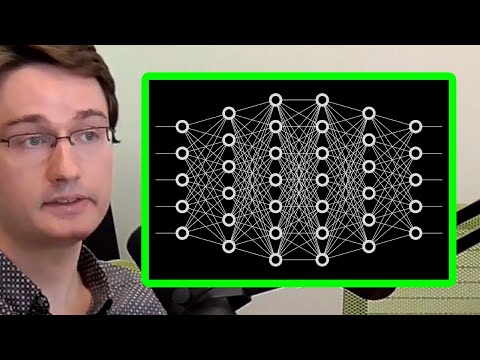 10:34ENLex FridmanPódcast · 2 vocesWhy Deep Learning Needs Rules: Chollet on Interpolation, Abstraction and Hybrid AIInvitado: François Chollet · Presenta: Lex FridmanFrançois Chollet explains why neural networks only interpolate between points they have seen, and why the best AI systems pair them with symbolic rules.
Cargar másMostrando 24 de 347