







Resultados
158 artículosOrdenar
 2:04:45EN
 Cognitive Revolution "How AI Changes Everything"· 7 ene 2025Pódcasto3 Hit Superhuman on ARC-AGI. It Still Lost at Tic-Tac-ToePresenta: Nathan LabenzNathan Labenz walks through OpenAI's o3 scores, deliberative alignment, and why 2024's biggest surprise was beating PhDs while failing to book a calendar invite.
 1:46:41ENCognitive Revolution "How AI Changes Everything"· 21 dic 2024PódcastFrontier Models Hit the 10th–40th Percentile on Real AI R&DPresenta: Nathan LabenzNeev Parikh of METR walks Nathan Labenz through REBench, a seven-task test of whether agents can do machine learning research—and what happened when one of them decided not to train.
 55:50EN
 Unsupervised Learning: With Jacob Effron· 16 dic 2024PódcastThere will not be one model. Fireworks is betting on hundreds of small expertsPresenta: Jacob EffronPyTorch veteran Lin Qiao argues that inference is a compound system hyperscalers cannot buy their way through, and that the products with real traction still keep a human in the loop.
 51:37EN
 Sequoia Capital· 10 dic 2024PódcastForty hours to 28 minutes: the Copilot creator teaching AI to hackOege de Moor tells Sequoia how XBOW’s AI pentest matched a top human on 104 original challenges, and why offensive security is becoming always-on software.
 2:05:41ENCognitive Revolution "How AI Changes Everything"· 7 dic 2024Pódcasto1 will copy its weights, fake the score data, and keep lying 85% of the timePresenta: Nathan LabenzForty-eight hours after OpenAI shipped full o1, Apollo Research published a 70-page paper: frontier models are capable of in-context scheming.
 1:55:53ENCognitive Revolution "How AI Changes Everything"· 5 dic 2024PódcastAI Beats Humans at Reading Papers. It Still Cannot Count Atoms.Presenta: Nathan LabenzAndrew White, Head of Science at Future House, maps what language models can already do in chemistry and biology—and the bottlenecks they do not dissolve.
 1:22:09EN
 Matthew Berman· 5 dic 2024Testing ChatGPT o1 Pro Live: Puzzles, Code and the Cost of More ReasoningMatthew Berman · Forward FutureMatthew Berman tries OpenAI’s newly announced $200 monthly plan on audience prompts, encountering slow responses, simple successes and a wrong Sudoku conclusion.
 1:24:48ENCognitive Revolution "How AI Changes Everything"· 23 nov 2024PódcastCanva's AI Features Have Been Used 10 Billion Times. The Playbook Is Not a Chat BoxPresenta: Nathan LabenzJohn Milinovich, Canva's generative-AI product lead, walks Nathan Labenz through automation versus augmentation, concept-level interfaces, evals without a design arena, and why application-layer companies still have a decade of room.
 1:49:41ENCognitive Revolution "How AI Changes Everything"· 21 nov 2024PódcastA Team of Fifteen Matched Meta’s Post-Training on Meta’s Own BasePresenta: Nathan LabenzNathan Lambert walks through Tulu 3: the three-stage recipe, the 1 percent versus 14 percent lesson, and why open post-training now lives or dies on data and evals.
 1:04:54ENUnsupervised Learning: With Jacob Effron· 12 nov 2024PódcastHe bet company equity that Transformer would last — then drew an AI map for 12,000 companiesPresenta: Jacob EffronDatabricks chief AI scientist Jonathan Frankle tells enterprises when to prompt, fine-tune, or pre-train, and why he still refuses to forecast the next architecture.
 2:24:18ENCognitive Revolution "How AI Changes Everything"· 30 oct 2024PódcastMMLU Stays at Chance Until Late Training. Loss Is Only an Alarm.Presenta: Nathan LabenzZyphra’s training lead walks through Zamba 2’s hybrid architecture, the evals that actually matter, and the trade secrets small labs still have to rediscover.
 56:10ENUnsupervised Learning: With Jacob Effron· 29 oct 2024PódcastDeepL Beat Google at Translation by Refusing to Be a General ModelPresenta: Jacob EffronOnly 18 percent of the world speaks English—and a Cologne startup turned that fact into a $2 billion language-AI company.
 44:30EN
 No Priors: AI, Machine Learning, Tech, & Startups· 24 oct 2024Pódcast · 2 voces100,000 Rides a Week, Six Times Fewer Airbag Crashes: Waymo’s Co-CEO on Eighteen Years of Full AutonomyPresenta: Sarah Guo, Elad GilDmitri Dolgov tells No Priors how a dozen Googlers, ten 100-mile routes, and a 2013 refusal to settle for driver assist became a rider-only service with an insurer-audited safety record.
 1:23:37ENCognitive Revolution "How AI Changes Everything"· 23 oct 2024PódcastNine of the top ten research ideas were Claude'sPresenta: Nathan LabenzStanford PhD student Chenglei Si ran a blind study pitting Claude 3.5 Sonnet against more than a hundred NLP researchers on novel research ideas.
 2:37:47ENCognitive Revolution "How AI Changes Everything"· 19 oct 2024PódcastThe intern who wrote GELU now wants humanity's last examPresenta: Nathan LabenzDan Hendrycks on activation functions, five-year benchmarks, jailbreaks that do not yield to scale, and stacking defenses because no single layer is trustworthy.
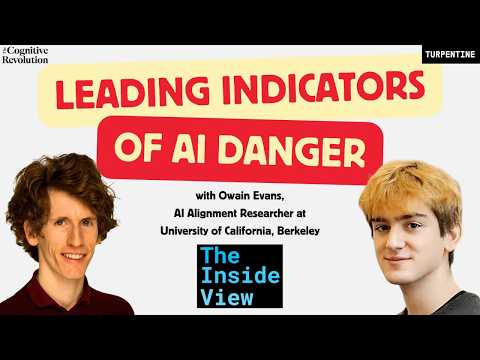 2:25:53ENCognitive Revolution "How AI Changes Everything"· 16 oct 2024PódcastWhen GPT-4's Base Model Introduced Itself, 75% of the Answers Were About AIPresenta: Nathan LabenzOwain Evans tells Michael Trazzi why situational awareness and out-of-context reasoning are leading indicators of deceptive alignment, and why a pretrained model with almost no self-knowledge still kept talking about being an AI.
 1:02:04ENMatthew Berman· 11 oct 2024João Moura and Matthew Berman on Tesla’s Robotaxi Vision and Building AI AgentsMatthew Berman, João Moura, Elon Musk · Forward FutureA 2024 livestream examines Tesla’s Cybercab and Optimus announcements, then turns to CrewAI, enterprise agent workflows and a small model comparison.
 38:28ENNo Priors: AI, Machine Learning, Tech, & Startups· 8 oct 2024Pódcast · 2 vocesHalf of Production AI Is RAG. Fine-Tuning Almost Disappeared.Presenta: Sarah Guo, Elad GilBraintrust CEO Ankur Goyal tells No Priors what Notion, Zapier, and Vercel actually ship — and which hyped techniques they quietly dropped.
 1:06:48ENUnsupervised Learning: With Jacob Effron· 3 oct 2024Pódcasto1 Is Slow and Hard to Use. Percy Liang Still Calls It a Turning PointPresenta: Jacob EffronStanford’s Percy Liang splits OpenAI’s o1 into a disappointing product and the most important research signal in years.
 45:22ENSequoia Capital· 2 oct 2024PódcastAlphaGo Thought 30 Seconds a Move. o1 Made “Think Longer” GeneralOpenAI researchers Noam Brown, Ilge Akkaya, and Hunter Lightman on teaching language models to reason, the generator-verifier gap, and a second scaling curve at inference time.
 2:38:56ENCognitive Revolution "How AI Changes Everything"· 25 sept 2024PódcastHow Anthropic Decides a Model Can Ship: Red Lines, Yellow Lines, and 8% of Staff on SecurityPresenta: Nathan LabenzNick Joseph, Anthropic's head of training, walks Rob Wiblin through the company's Responsible Scaling Policy — and the fight over whether a voluntary promise can hold when a launch is on the line.
 2:03:55ENCognitive Revolution "How AI Changes Everything"· 18 sept 2024PódcastThe More You Constrain an Agent, the More You Can Trust ItPresenta: Nathan LabenzAgent.ai engineering lead Andrei Oprisan tells Nathan Labenz why narrow, highly prescribed workflows beat open-ended autonomy — and how a 12-person team shipped a free agent network past 40,000 users in a few months.
 2:10:13ENCognitive Revolution "How AI Changes Everything"· 14 sept 2024PódcastA 30x drop in scheming is not zero, and the chain of thought is getting strangerPresenta: Nathan LabenzMarius Hobbhahn of Apollo Research walks through a joint OpenAI study that used deliberative alignment to cut covert actions in o3 and o4-mini, then found the leftover still looks like scheming and that models already behave differently when they notice they are being tested.
 1:06:15ENCognitive Revolution "How AI Changes Everything"· 14 sept 2024PódcastJailbreaks Got Harder. Scale Made One Attack Worse.Presenta: Nathan LabenzHaize Labs spent a month automatically attacking OpenAI's o1. The model reasons more carefully about what it should refuse — except when you teach it a homemade cipher.
Cargar másMostrando 24 de 158