









Results
33 articlesSort
 52:05EN
 Jane Street· Oct 24, 2025Corwin de Zahr: Exploring OCaml Runtime Safety Through a CTF ChallengeCorwin de Zahr · Jane StreetA deliberately restricted OCaml sandbox becomes a way to examine type safety, callbacks, memory representation and binary debugging.
 47:08ENJane Street· Apr 3, 2025Chris Casinghino on Making OCaml Safe for Performance EngineeringChris Casinghino · Jane StreetJane Street’s OCaml extensions use layouts and modes to offer more control over memory and parallelism while preserving safety and familiar programming patterns.
 12:43ENJane Street· Dec 20, 2024How OCaml Represents Values in MemoryA practical tour of immediate integers, heap blocks, runtime tags and variant constructors, illustrated with OCaml's Obj module.
 1:03:21ENJane Street· Dec 9, 2024Horace He on Building ML Systems for Trillion-Trillion OperationsHorace He · MetaHow GPU bottlenecks, compiler design and distributed parallelism shape the systems behind large-scale model training.
 9:25ENJane Street· Oct 1, 2024Richard Eisenberg: Using OCaml’s Coercion OperatorRichard Eisenberg · Jane StreetA practical tour of subtyping, polymorphic variants and private type abbreviations, with no runtime conversion cost.
 8:06ENJane Street· Aug 7, 2024How OCaml's Proposed Include Functor Syntax Reduces RepetitionRichard Eisenberg · Jane StreetA reverse-array example shows how to derive common module functions from a minimal implementation without an extra wrapper module.
 14:36ENJane Street· Jun 24, 2024Programming with OCaml's Local ModeRichard Eisenberg · Jane StreetAn example shows how a local list can contain global values, why a non-escaping annotation alone does not ensure stack allocation, and where the experimental feature remains awkward.
 11:28ENJane Street· Jun 13, 2024OCaml Local Types: Regional Parameters and Loop RegionsRichard Eisenberg · Jane StreetA demonstration explains why some local parameters can cross a function boundary and how loop regions reclaim allocations.
 9:14ENJane Street· May 29, 2024OCaml Local Function Types: Why Partial Application Can EscapeRichard Eisenberg · Jane StreetRichard Eisenberg uses a list-append example to show how a local argument changes the mode of a partially applied function in Jane Street’s OCaml compiler branch.
 15:59ENJane Street· May 7, 2024Tail Calls and Local Regions in OCamlRichard Eisenberg · Jane StreetA list-counting example reveals why a local closure can escape at a tail call, and how regional mode and [@nontail] affect the result.
 3:30ENJane Street· Mar 13, 2024Richard Eisenberg on Jane Street's OCaml ExperimentsRichard Eisenberg · Jane StreetJane Street's compiler team is exploring unboxed types, locality modes, and data-race-free parallelism to make OCaml's performance and memory management better suited to its needs.
 11:07ENJane Street· Feb 29, 2024How OCaml Locals Use a Separate StackRichard Eisenberg · Jane StreetA list example shows how region-scoped local values can avoid repeated garbage-collected allocations.
 23:25ENJane Street· Feb 20, 2024Richard Eisenberg: How OCaml Locals Reduce Garbage-Collected AllocationRichard Eisenberg · Jane StreetAn annotated list-processing example shows why locality must be preserved both when values are created and when functions consume them.
 22:27ENJane Street· Feb 7, 2024How OCaml Infers LocalityRichard Eisenberg · Jane StreetA look at local and global mode inference, module signatures, mode crossing for integers, and conversions between function types.
 15:17ENJane Street· Jan 31, 2024OCaml Locals, Modes, and SubmodingRichard Eisenberg · Jane StreetA worked explanation of how local and global modes control escaping values, and how those modes interact with function types.
 12:52ENJane Street· Jan 23, 2024OCaml Local Variables, Return Values and RegionsRichard Eisenberg · Jane StreetA worked example shows how `local_` and `exclave_` let a function accept a local value and return a local structure in its caller's region.
 8:52ENJane Street· Jan 5, 2024Introducing Local Parameters in OCamlRichard Eisenberg · Jane StreetA demonstration of how Jane Street's experimental local mode restricts escaping values and makes function interfaces easier to reason about.
 1:05:59ENJane Street· Sep 27, 2019Derek Dreyer: Proving the Safety of Rust with RustBelt and IrisDerek Dreyer · Max Planck Institute for Software SystemsRust combines safe interfaces with libraries that use unsafe code internally. Derek Dreyer explains how RustBelt verifies those libraries and why its proof needs an expressive logic for concurrency.
 1:08:44ENJane Street· Mar 8, 2019Nathan Linger on Ontology: A Language-Oriented Permissions SystemNathan Linger · Jane StreetHow Jane Street represents permissions as typed declarations and presents them through an English-language interface.
 1:18:13ENJane Street· Feb 11, 2019Lindsey Kuper on Abstractions for Correct and Efficient Parallel ComputingLindsey Kuper · University of California, Santa CruzFrom lattice-based shared state to non-invasive parallel languages and neural-network verification, high-level abstractions can make systems both safer and faster.
 1:14:37ENJane Street· Apr 5, 2018Adding an Effect System to OCamlLeo White · Jane StreetA prototype brings algebraic effects into OCaml’s type system and explores how to track exceptions, I/O and locally mutable state.
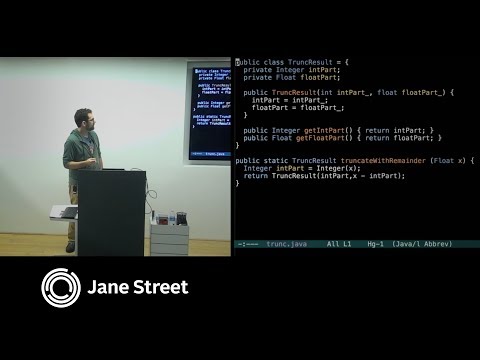 1:08:43ENJane Street· Mar 19, 2018Ron Minsky on Types and Why They Matter in SoftwareYaron Minsky · Jane StreetType systems can make programs faster, catch mistakes and guide large refactorings, but their value depends on the language and the work. Ron Minsky explains the trade-offs through practical examples.
 1:10:18ENJane Street· Feb 28, 2018Shriram Krishnamurthi on Designing Computing Curricula for Real ClassroomsShriram Krishnamurthi · Brown UniversityThe Bootstrap project treats curriculum design as an engineering problem: start with goals and constraints, then support teachers and measure learning.
 52:51ENJane Street· Jun 20, 2017Caveat Configurator: When Configuration Becomes CodeDominick LoBraico · Jane StreetDominick LoBraico explains why flexible OCaml plugins created production problems at Jane Street, and how configuration generation and disciplined plugin management address them.
Load moreShowing 24 of 33