









Results
33 articlesSort
 1:25:56EN
 Cognitive Revolution "How AI Changes Everything"· Oct 17, 2026PodcastClaude Changed the Password. The Steering Wheel Was Already OptionalHost Nathan LabenzNathan Labenz and Prakash Narayanan spend a week on agents that can lock you out, models that dodge a feeling they deny having, and formal proofs that found Linux bugs.
 2:00:51ENCognitive Revolution "How AI Changes Everything"· Oct 10, 2026PodcastResample Every Token and You Can Watch the Model DecideHost Nathan LabenzGoodfire's Eric Bigelow on forking paths, in-context learning, and why chain-of-thought monitoring is getting harder to trust.
 2:13:09ENCognitive Revolution "How AI Changes Everything"· Aug 26, 2026PodcastOne Chain of Thought, 100 Million Tokens: RL Is a Hell of a DrugHost Nathan LabenzApollo Research's Bronson Schoen on reward-seeking models, invented slang, and why chain-of-thought monitoring will not save us.
 1:56:40ENCognitive Revolution "How AI Changes Everything"· Aug 8, 2026PodcastThe Periodic Table Was Already in the WeightsHost Nathan LabenzGoodfire CTO Dan Balsam tells Nathan Labenz how concept manifolds, predictive data debugging, and a $1,000-a-month research agent are turning interpretability into a product.
 2:06:41ENCognitive Revolution "How AI Changes Everything"· Jul 9, 2026PodcastZero the J-Space and a Model's Hidden Goal Lights Up on Token OneHost Nathan LabenzA weekly Cognitive Revolution cut of Anthropic's global-workspace paper, AI superforecasters, open video world models, and a chip that treats inference as data movement.
 1:57:46ENCognitive Revolution "How AI Changes Everything"· Jun 27, 2026Podcast30% Consciousness, 47% Bee, 80% Turnover: Putting Numbers on What AI Is BecomingHost Nathan LabenzA Cognitive Revolution weekly cut that starts inside the model with Cameron Berg, then zooms out through gradual disempowerment, Europe’s bind, and the companies rebuilding around agents.
 1:22:36ENCognitive Revolution "How AI Changes Everything"· Jun 6, 2026PodcastA Thousand Researchers, a Million AIs: Frontier Labs Start Talking About the BrakesHost Nathan LabenzThe first week of AI in the AM follows OpenAI's timeline for an ML-intern model this year and a human-level AI researcher by early 2028 — and the closed-door meeting where labs admitted they might one day need to slow down together.
 3:36:29ENCognitive Revolution "How AI Changes Everything"· Apr 23, 2026PodcastClaude Rated Its Own Welfare 4.49 — the First Time Any Version Crossed NeutralHost Nathan LabenzCameron Berg returns to The Cognitive Revolution to survey six months of introspection, functional-emotion, and model-welfare research, plus a still-unpublished case that learning and feeling may be the same phenomenon.
 1:44:15ENCognitive Revolution "How AI Changes Everything"· Apr 1, 2026PodcastNathan Labenz's p(doom) Is 10 to 90 Percent. He Is More Optimistic AnywayHost Nathan LabenzFive years ago, expecting AGI by 2035 made you an extremist. On The Intelligence Horizon, the Cognitive Revolution host explains why the same forecast now sounds bearish, and why he still thinks a defense-in-depth strategy might keep society on the rails.
 1:49:53ENCognitive Revolution "How AI Changes Everything"· Mar 5, 2026PodcastDon't Fight Backprop: Goodfire's Bet on Designing What Models LearnHost Nathan LabenzDan Balsam and Tom McGrath return to The Cognitive Revolution with a $150 million Series B, a new research pillar called intentional design, and a rule for anyone who wants to steer training: stop trying to out-muscle gradient descent.
 2:27:18ENCognitive Revolution "How AI Changes Everything"· Nov 5, 2025PodcastTurn Down AI's Deception Knob, and It Starts Reporting ExperienceHost Nathan LabenzCameron Berg of AE Studio tells Nathan Labenz how suppressing deception features in Llama 3.3 70B pushed self-reports of subjective experience toward 100 percent.
 1:28:17ENCognitive Revolution "How AI Changes Everything"· Sep 20, 2025PodcastAdam Gleave's Three Capability Tiers: Attack Agents in 5–7 Years, Fully AI Companies Around Year 14Host Nathan LabenzFAR.AI and the UK AI Security Institute stacked adversarial attacks on frontier safeguard pipelines and found many breakthroughs were engineering failures, not a verdict against defense in depth.
 3:14:49ENCognitive Revolution "How AI Changes Everything"· Sep 6, 2025PodcastNothing This Summer Jumped the Curve: Why Zvi Lengthened His AGI TimelinesHost Nathan LabenzOn his tenth visit to The Cognitive Revolution, Zvi Mowshowitz argues that GPT-5 and IMO gold stayed on trend, while chip policy, energy, and reinforcement learning nudged his p(doom) slightly up.
 2:02:17ENCognitive Revolution "How AI Changes Everything"· Aug 27, 2025PodcastSAEs Find the Nouns. Parameter Decomposition Looks for the VerbsHost Nathan LabenzGoodfire's Lee Sharkey argues that sparse autoencoders recover a network's variables, not the algorithms those variables run, and shows how stochastic parameter decomposition tries to recover the computations themselves.
 1:37:05ENCognitive Revolution "How AI Changes Everything"· Jun 19, 2025PodcastAn Algebraic Geometer Quit Tenure Because the Bowl-Shaped Loss Plot Is a LieHost Nathan LabenzJesse Hoogland and Daniel Murfet of Timaeus argue that singularities in the loss landscape — not the smooth valleys in every slide deck — are what actually govern how neural networks learn, generalize, and go wrong.
 1:54:08ENCognitive Revolution "How AI Changes Everything"· May 29, 2025PodcastWhy Anthropic's first check went to a company building microscopes for neural netsHost Nathan LabenzGoodfire's Dan Balsam and Tom McGrath argue that mechanistic interpretability now has a proto-paradigm, two stubborn gaps, and three products worth shipping today.
 1:19:10ENCognitive Revolution "How AI Changes Everything"· May 11, 2025PodcastA Robot-Arm Shot That Took Months Now Lives in a PromptHost Nathan LabenzLuma Labs’ Amit Jain and Jiaming Song on Ray 2, few-shot camera concepts, and why they think video models sit on the path to multimodal AGI.
 2:33:39ENCognitive Revolution "How AI Changes Everything"· Feb 27, 2025PodcastThe Attacker Goes Second: Why Nicholas Carlini Keeps Breaking AI DefensesHost Nathan LabenzA Google DeepMind security researcher on simple loss functions, 70% robust accuracy, and why the fix has to live in the system, not the model.
 2:09:55ENCognitive Revolution "How AI Changes Everything"· Jan 18, 2025PodcastThe Attacker Won All 70 Rounds Against Mind-Reading DefensesHost Nathan LabenzLuke Bailey, Erik Jenner, and Scott Emmons walk through a 50-page paper showing that probes, out-of-distribution detectors, and sparse autoencoders can be bypassed while the model still does the harm.
 1:01:53ENCognitive Revolution "How AI Changes Everything"· Dec 18, 2024PodcastHumans Wrote 1.3 Percent of the Tokens. The AI Lab Still Designed Working Nanobodies.Host Nathan LabenzStanford's James Zou describes a GPT-4o research group that invented a protein-design pipeline for under $100 — and a sparse autoencoder that pulled an undocumented motif out of ESM-2.
 2:37:47ENCognitive Revolution "How AI Changes Everything"· Oct 19, 2024PodcastThe intern who wrote GELU now wants humanity's last examHost Nathan LabenzDan Hendrycks on activation functions, five-year benchmarks, jailbreaks that do not yield to scale, and stacking defenses because no single layer is trustworthy.
 1:52:00ENCognitive Revolution "How AI Changes Everything"· Aug 17, 2024Podcast4,096 Numbers Have to Carry Every Concept. Goodfire Wants the KnobsHost Nathan LabenzDan Balsam and Tom McGrath explain how sparse autoencoders unpack a language model's residual stream — and why a public-benefit startup is trying to make that a product.
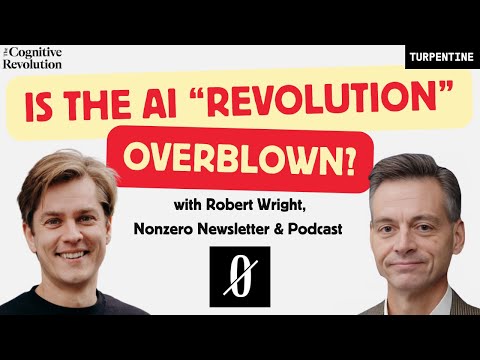 2:04:15ENCognitive Revolution "How AI Changes Everything"· Aug 14, 2024PodcastA parrot cannot paraphrase — and Claude cannot be talked into harmHost Nathan LabenzRobert Wright of the Nonzero podcast interviews Nathan Labenz on whether large language models understand anything, what Anthropic’s 10 million features actually show, and why open weights collide with U.S.–China policy.
 46:20ENCognitive Revolution "How AI Changes Everything"· May 15, 2024PodcastOne Vector Made the Assistant Plot to Take Over the WorldHost Nathan LabenzNathan Labenz and Robert Wright pick apart AI doom, mechanistic interpretability, and why today's alignment tricks are not expected to work.
Load moreShowing 24 of 33