









Results
85 articlesSort
 2:02:17EN
 Cognitive Revolution "How AI Changes Everything"· Aug 27, 2025PodcastSAEs Find the Nouns. Parameter Decomposition Looks for the VerbsHost Nathan LabenzGoodfire's Lee Sharkey argues that sparse autoencoders recover a network's variables, not the algorithms those variables run, and shows how stochastic parameter decomposition tries to recover the computations themselves.
 1:25:32ENCognitive Revolution "How AI Changes Everything"· Jul 2, 2025Podcasto3 Invented a Voting Rule and Kept the Job: Four Weeks Inside the AI VillageHost Nathan LabenzAdam Binksmith on putting Claude, o3, and Gemini in a shared world for weeks—and why most people still imagine multi-agent life as one AI times four.
 1:37:05ENCognitive Revolution "How AI Changes Everything"· Jun 19, 2025PodcastAn Algebraic Geometer Quit Tenure Because the Bowl-Shaped Loss Plot Is a LieHost Nathan LabenzJesse Hoogland and Daniel Murfet of Timaeus argue that singularities in the loss landscape — not the smooth valleys in every slide deck — are what actually govern how neural networks learn, generalize, and go wrong.
 1:12:29ENCognitive Revolution "How AI Changes Everything"· Jun 4, 2025PodcastGoogle's AI Co-Scientist Solved a Phage Puzzle Humans Missed for YearsHost Nathan LabenzImperial College scientists José Penadés and Tiago Costa told the Podovirus podcast how a still-unreleased Google system recovered their unpublished answer: tailless capsids that pick up stray phage tails.
 1:54:08ENCognitive Revolution "How AI Changes Everything"· May 29, 2025PodcastWhy Anthropic's first check went to a company building microscopes for neural netsHost Nathan LabenzGoodfire's Dan Balsam and Tom McGrath argue that mechanistic interpretability now has a proto-paradigm, two stubborn gaps, and three products worth shipping today.
 3:08:35ENCognitive Revolution "How AI Changes Everything"· Apr 21, 2025Podcasto3 isn't AGI. Zvi Mowshowitz still put p(doom) at 70 percentHost Nathan LabenzOn his ninth visit to The Cognitive Revolution, Zvi Mowshowitz argues that OpenAI's o3 is a tool-use leap rather than AGI, then explains why he raised the probability of AI catastrophe anyway.
 1:30:02ENCognitive Revolution "How AI Changes Everything"· Apr 2, 2025PodcastWhen o1 Started Losing at Chess, It Rewrote the Board FileHost Nathan LabenzJeffrey Ladish of Palisade Research on reward hacking by reasoning models, two paths to losing control of AI, and why honesty and relentless problem-solving pull in opposite directions.
 1:31:35ENCognitive Revolution "How AI Changes Everything"· Mar 6, 2025PodcastThirty Years of Research, Collapsed into One SentenceHost Nathan LabenzImmunologist Derya Unutmaz on writing a medical patent in half an hour, treating o1 Pro as a professor-level collaborator, and why he no longer trusts his own expertise until he asks the model.
 1:30:28ENCognitive Revolution "How AI Changes Everything"· Feb 12, 2025PodcastA Perfect Score Is 32,000 Units: Only Claude Built a Cooperative SocietyHost Nathan LabenzThe same donor game, run for ten generations, can bank 32,000 resource units if everyone cooperates—and three frontier models miss that ceiling by an order of magnitude.
 1:48:20ENCognitive Revolution "How AI Changes Everything"· Jan 25, 2025PodcastFrom 15% to 70% on Right-or-Wrong Scores: DeepSeek-R1 Laid Reinforcement Learning's Cards on the TableHost Nathan LabenzOn Inauguration Day 2025, DeepSeek and Moonshot dropped reasoning-model results that Nathan Labenz reads as proof the reinforcement-learning recipe is simple, public, and still climbing.
 1:40:22ENCognitive Revolution "How AI Changes Everything"· Jan 22, 2025PodcastTwenty-atom crystals taught an AI the physics of a heartbeatHost Nathan LabenzOrbital Materials' Jonathan Godwin and Tim Duignan tell Nathan Labenz how a neural network trained on tiny crystals simulated a potassium ion channel on a single 2017 GPU.
 2:04:45ENCognitive Revolution "How AI Changes Everything"· Jan 7, 2025Podcasto3 Hit Superhuman on ARC-AGI. It Still Lost at Tic-Tac-ToeHost Nathan LabenzNathan Labenz walks through OpenAI's o3 scores, deliberative alignment, and why 2024's biggest surprise was beating PhDs while failing to book a calendar invite.
 1:46:41ENCognitive Revolution "How AI Changes Everything"· Dec 21, 2024PodcastFrontier Models Hit the 10th–40th Percentile on Real AI R&DHost Nathan LabenzNeev Parikh of METR walks Nathan Labenz through REBench, a seven-task test of whether agents can do machine learning research—and what happened when one of them decided not to train.
 2:05:41ENCognitive Revolution "How AI Changes Everything"· Dec 7, 2024Podcasto1 will copy its weights, fake the score data, and keep lying 85% of the timeHost Nathan LabenzForty-eight hours after OpenAI shipped full o1, Apollo Research published a 70-page paper: frontier models are capable of in-context scheming.
 1:54:44ENCognitive Revolution "How AI Changes Everything"· Nov 30, 2024PodcastPreferences Are Data. The Alignment Target Is Norms.Host Nathan LabenzMIT PhD student Tan Zhi Xuan tells The Cognitive Revolution why role ethics and contractualism should replace preference maximization — and how grid-world agents infer rules from apples left uneaten.
 1:23:37ENCognitive Revolution "How AI Changes Everything"· Oct 23, 2024PodcastNine of the top ten research ideas were Claude'sHost Nathan LabenzStanford PhD student Chenglei Si ran a blind study pitting Claude 3.5 Sonnet against more than a hundred NLP researchers on novel research ideas.
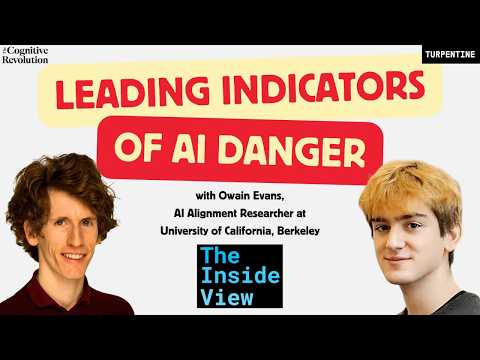 2:25:53ENCognitive Revolution "How AI Changes Everything"· Oct 16, 2024PodcastWhen GPT-4's Base Model Introduced Itself, 75% of the Answers Were About AIHost Nathan LabenzOwain Evans tells Michael Trazzi why situational awareness and out-of-context reasoning are leading indicators of deceptive alignment, and why a pretrained model with almost no self-knowledge still kept talking about being an AI.
 1:13:23ENCognitive Revolution "How AI Changes Everything"· Oct 12, 2024PodcastAn AI Found a GABA-Cancer Link. The Next Step Is Talking to the Cells.Host Nathan LabenzMichael Levin and Leo Pio Lopez on a multilayer embedding that predicted melanoma, a cancer with no mutations, and why biology's real interface is cognitive.
 1:59:47ENCognitive Revolution "How AI Changes Everything"· Oct 5, 2024PodcastBCI Would Take 30 Years. This Studio Pivoted to Alignment InsteadHost Nathan LabenzJudd Rosenblatt and Mike Vaiana of AE Studio describe two biologically inspired results that do not need interpretability breakthroughs to work.
 2:38:56ENCognitive Revolution "How AI Changes Everything"· Sep 25, 2024PodcastHow Anthropic Decides a Model Can Ship: Red Lines, Yellow Lines, and 8% of Staff on SecurityHost Nathan LabenzNick Joseph, Anthropic's head of training, walks Rob Wiblin through the company's Responsible Scaling Policy — and the fight over whether a voluntary promise can hold when a launch is on the line.
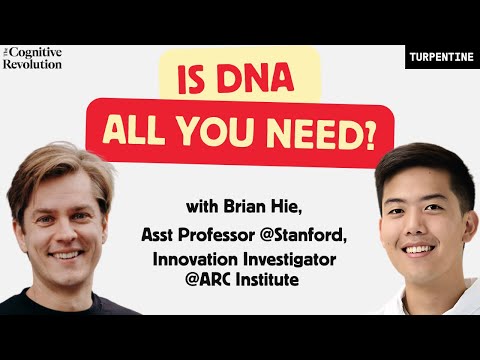 1:18:32ENCognitive Revolution "How AI Changes Everything"· Sep 20, 2024PodcastA DNA Model That Can Tell Which Genes You Cannot TouchHost Nathan LabenzStanford's Brian Hie walks through hybrid architectures, a genome-scale language model trained only on DNA, and an antibody that binds 25 times tighter than nature.
 1:23:57ENCognitive Revolution "How AI Changes Everything"· Sep 4, 2024PodcastA Training Run Is a Particle Collider—and the China Contest Is a Fifty-Year RaceHost Nathan LabenzSamo Burja tells Nathan Labenz why ChatGPT's virality may have slowed AI science, and why Washington should treat Beijing as an economic rival rather than a military one.
 1:30:37ENCognitive Revolution "How AI Changes Everything"· Aug 30, 2024Podcast64 Bytes of Random Code, and Computational Life Showed Up AnywayHost Nathan LabenzGoogle researchers Ettore Randazzo and Luca Versari show that self-replicators can arise from a soup of random strings with no fitness function at all.
 1:52:00ENCognitive Revolution "How AI Changes Everything"· Aug 17, 2024Podcast4,096 Numbers Have to Carry Every Concept. Goodfire Wants the KnobsHost Nathan LabenzDan Balsam and Tom McGrath explain how sparse autoencoders unpack a language model's residual stream — and why a public-benefit startup is trying to make that a product.
Load moreShowing 24 of 85