








Ergebnisse
66 ArtikelSortieren
 26:41EN
 Latent Space· 22. Okt. 2026Podcast · 2 StimmenAnekha Sokhal on Moshi, a Recommendation Engine for Commodity TradersGast: Anekha Sokhal · Moderation: swyxThe Moshi founder tells swyx how she would rebuild a trader’s workflow: connect market data, private files and conflicting sources, then push the second-order effects people would otherwise miss. The hard part is not the dashboard. It is getting someone to actually use it.
 52:27EN
 Sequoia Capital· 1. Sept. 2026PodcastAfter Two Dozen Police Departments Said No, They Built an Anti-Network-Effect AI CompanyA Wisconsin county had 300 gigabytes sitting on a cold case—and Peregrine's founders still refuse to take the credit.
 34:51EN
 No Priors: AI, Machine Learning, Tech, & Startups· 27. Aug. 2026Podcast · 2 StimmenGoogle Paid $10 Million for a Bankrupt Airline’s Data. That’s the Moat.Moderation: Sarah Guo, Elad GilEon co-founders Ofir Ehrlich and Gonen Stein argue that models and compute are rented commodities — the only asset enterprises can actually keep is their data.
 40:56ENSequoia Capital· 10. März 2026PodcastFour of the Top Five Defense Primes Still Run Hardware Tests on PowerPointNominal’s cofounders argue that hardware never got the last twenty years of software infrastructure, and that physical AI will stall until test data lives in one place.
 1:04:51EN
 Cognitive Revolution "How AI Changes Everything"· 1. Feb. 2026Podcast125 million cells took a decade. The next billion takes monthsModeration: Nathan LabenzMark Zuckerberg and Priscilla Chan on pairing a frontier biology lab with a frontier AI lab so models train on data that was designed for them.
 1:18:05EN
 Unsupervised Learning: With Jacob Effron· 18. Dez. 2025PodcastThe Real Bottleneck in AI Research Is Compute, Not IdeasModeration: Jacob EffronAfter NeurIPS, Ari Morcos and Rob Toews sit down with Jacob Effron to argue about plateauing models, SSI’s secrecy, OpenAI’s cash burn, and a set of spicy 2026 bets.
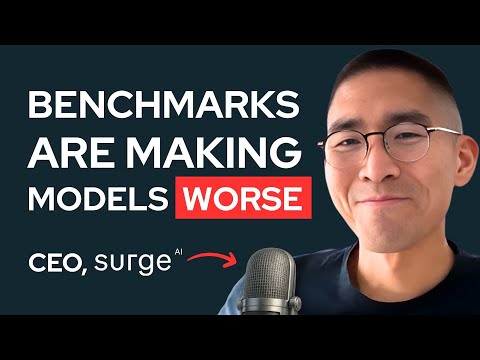 48:00ENUnsupervised Learning: With Jacob Effron· 15. Dez. 2025PodcastA Two-Second Vote Is Training Models to Be ClickbaitModeration: Jacob EffronSurge AI CEO Edwin Chen tells Redpoint why LMArena rewards length and emojis, how one lab's models got worse for a year, and why frontier labs are no longer on the same path.
 1:32:38ENCognitive Revolution "How AI Changes Everything"· 6. Dez. 2025PodcastPolish Is 1% of Frontier Training Data, So Poland Built Its Own ModelModeration: Nathan LabenzMarek Kozlowski of Poland's National Information Processing Institute explains how PLLuM uses language adaptation, organic instructions, and on-prem small models to keep a mid-size country in control of its AI.
 39:16ENNo Priors: AI, Machine Learning, Tech, & Startups· 19. Nov. 2025Podcast · 2 Stimmen500 Gloves, 10 Million Trajectories, and a $10,000 Home RobotModeration: Sarah Guo, Elad GilSunday Robotics co-founders Tony Zhao and Cheng Chi map the gap between a scalable imitation-learning recipe and a machine that actually does the dishes.
 41:36ENSequoia Capital· 18. Nov. 2025PodcastFour Months to Drive Tokyo: How Wayve Bet the Company on One End-to-End NetworkWayve CEO Alex Kendall tells Sequoia’s Training Data why AV 2.0 ditches HD maps and hand-written stacks for a foundation model that can adapt to a new car and a new country in weeks.
 48:14ENNo Priors: AI, Machine Learning, Tech, & Startups· 13. Nov. 2025Podcast · 2 StimmenA New Drug Burns $2 Billion and 10 Years. Benchling's CEO Wants AI to Cut That to ThreeModeration: Sarah Guo, Elad GilMost medicines fail in years seven to ten, after hundreds of millions have already gone into the clinic—and Sajith Wickramasekara thinks sending things to space may already be easier.
 1:16:53ENUnsupervised Learning: With Jacob Effron· 24. Okt. 2025PodcastKarpathy Called Today's Models Slop. His Decade Timeline Still Sounds BullishModeration: Jacob EffronDatology AI's Ari Morcos and Radical Ventures' Rob Toews walk through Karpathy's cold water, OpenAI's dealmaking, and who actually pays for the data-center boom.
 1:01:49ENCognitive Revolution "How AI Changes Everything"· 2. Okt. 2025PodcastChatGPT's Co-Creator Left to Put Nature in the Reward LoopModeration: Nathan LabenzLiam Fedus and Ekin Dogus Cubuk on why language models still fail at physics, why literature data is too noisy to train on, and why Periodic Labs is aiming at a 200K superconductor.
 1:22:07ENCognitive Revolution "How AI Changes Everything"· 25. Sept. 2025PodcastEvery payment is a frame in a movie. Stripe’s foundation model took card-testing detection from 59% to 97%Moderation: Nathan LabenzEmily Sands, Stripe’s head of data and AI, explains how a domain-specific payments model, shared embeddings, and mixed rules turn a $1.4 trillion network into compounding advantage.
 1:55:02ENCognitive Revolution "How AI Changes Everything"· 30. Aug. 2025PodcastA hundred experiments a day, and the valley of death in materialsModeration: Nathan LabenzRadical AI’s co-founders tell Nathan Labenz how a closed loop of frontier models and a self-driving lab is meant to collapse a forty-year materials cycle into less than a decade.
 57:52ENUnsupervised Learning: With Jacob Effron· 13. Aug. 2025PodcastThey Aimed for 1%. The Lab Hit 20%. Chai Discovery Moved Antibody Design Onto the Computer.Moderation: Jacob EffronJoshua Meier on three waves of AI drug discovery, why Chai-2 behaves like Photoshop for molecules, and why a 1% hit rate was supposed to be enough to change the industry.
 32:59ENNo Priors: AI, Machine Learning, Tech, & Startups· 24. Juli 2025Podcast · 2 StimmenA Hundred People, a Billion in Revenue, and Zero Venture MoneyModeration: Sarah Guo, Elad GilSurge AI founder Edwin Chen on why quality human data is a poetry problem, not a bounding-box problem, and why leaderboards keep training models to write clickbait.
 1:42:06ENCognitive Revolution "How AI Changes Everything"· 8. Juli 2025PodcastEvery Frontier Lab Is Spending a Billion a Year on Data. Here Is Where It GoesModeration: Nathan LabenzLabelbox CEO Manu Sharma on the $15 billion Scale deal, RL “gyms,” $250,000 trainers, and why post-training now eats the budget that used to belong to pre-training.
 44:21ENUnsupervised Learning: With Jacob Effron· 4. Juni 2025PodcastMercor's CEO: Knowledge Work's Next Job Is Writing EvalsModeration: Jacob EffronBrendan Foody tells Redpoint how Mercor turned AI hiring and expert data into a $100 million round — and why he thinks a huge slice of white-collar work will become creating tests for models.
 40:54ENNo Priors: AI, Machine Learning, Tech, & Startups· 17. Apr. 2025Podcast · 2 StimmenDiscovery rates collapsed tenfold. KoBold still found a 5% copper depositModeration: Sarah Guo, Elad GilJosh Goldman explains why KoBold Metals treats mineral exploration as an information problem, pairing AI with century-old maps to hunt lithium and copper.
 1:43:54ENCognitive Revolution "How AI Changes Everything"· 23. März 2025PodcastA Year to Grow a Brain Organoid, an Hour to Simulate ItModeration: Nathan LabenzStanford postdoc Siyu He tells Nathan Labenz how Squidiff and CORAL move single-cell and spatial experiments into the computer — and where the models still cannot go.
 35:14ENNo Priors: AI, Machine Learning, Tech, & Startups· 20. März 2025Podcast · 2 StimmenRobots Have No Wikipedia. Chelsea Finn Is Starting With Three Buildings.Moderation: Sarah Guo, Elad GilPhysical Intelligence’s cofounder tells No Priors why a generalist robot model has to be trained across embodiments, why open-sourcing hardware is a bet against the problem going unsolved, and why humanoids are a little overrated.
 32:46ENSequoia Capital· 25. Feb. 2025PodcastDon't draw the flowchart: OpenAI's Deep Research team on training agents end to endIsa Fulford and Josh Tobin explain why Deep Research was trained with reinforcement learning on hard browsing tasks instead of a human-written graph of model calls.
 57:41ENNo Priors: AI, Machine Learning, Tech, & Startups· 25. Feb. 2025Podcast · 2 StimmenA Hundred Million Cells, Four People, Three Days: Biology's ImageNet MomentModeration: Sarah Guo, Elad GilVevo Therapeutics and the Arc Institute open-sourced Tahoe-100M and a 230-million-cell atlas in the same week — and argued that virtual cells, not just protein folders, are the next language model of biology.
Mehr laden24 von 66 angezeigt