


Ergebnisse
1.648 ArtikelSortieren
 35:19EN
 AI Engineer· 25. Okt. 2026SallyAnn DeLucia: How to Write Your First AI EvalSallyAnn DeLucia · Arize AITurn an agent’s real traces into concrete pass/fail criteria, then build an LLM judge you can test, align with people, and run in production.
 1:50:48EN
 Y Combinator· 24. Okt. 2026Why Inference Matters 12× More Than TrainingFrançois Chaubard, Dan Fu, Jeff Morgan, Joe Fioti, Liangsheng Yin · Y CombinatorYC Paper Club walks the inference stack from an API request down to GPU kernels. Four talks from Together AI, Ollama, Luminal, and SGLang argue that serving quality, not just training FLOPs, is where most of the compute and the money now sit.
 34:11EN
 GOTO Conferences· 23. Okt. 2026Anatoliy Bilenko and Alberto Carretero: Making Database Protocols Reliable with Formal Methods and AIAnatoliy Bilenko, Alberto Carretero · CanonicalCanonical’s database engineers connect executable specifications, model-based tests, failure exploration, and reconstructed execution histories—and explain why none of these techniques proves a real system correct on its own.
 34:35EN
 SemiAnalysis· 23. Okt. 2026Podcast · 3 StimmenSemiAnalysis on ASML's Hybrid-Bonding Patents, HBM Economics and the Next Tool EcosystemGast: Sherry Zhang, Howie · Moderation: Jordan NanosJordan Nanos, Sherry Zhang and Howie examine a track-based bonding design that brings the wafer to the die, then explain why adoption depends on precision, cleanliness, economics and a changing supply chain.
 1:09:00EN
 Dwarkesh Patel· 22. Okt. 2026Podcast · 9 StimmenDwarkesh Patel: What will computer chips look like in 2045?Gast: Chris Auth, Kevin Fischer, Jack Kavalieros, Tyler Osborn, Pushkar Ranade, Gary Dickerson, Peter Wennink, Elon Musk · Moderation: Dwarkesh PatelAfter two days inside Intel’s most advanced fab, Dwarkesh Patel walks through gate-all-around, backside power, High-NA EUV, ruthenium, CFET, and hybrid bonding — and asks Intel’s leadership how the industry can possibly meet AI’s 3×-a-year compute demand when the world’s chipmaking tools cannot.
 1:25:33EN
 Latent Space· 22. Okt. 2026Podcast · 2 StimmenWhy GPU Capacity Comes in Three-Year Rectangles — Erik Bernhardsson, ModalGast: Erik Bernhardsson · Moderation: Vibhu SapraModal’s CEO tells Latent Space why AI demand almost never looks like a three-year GPU contract, how the company pools compute across thousands of customers, and why sandboxes grew from a product they almost killed into a third of revenue.
 1:25:56EN
 Cognitive Revolution "How AI Changes Everything"· 17. Okt. 2026PodcastClaude Changed the Password. The Steering Wheel Was Already OptionalModeration: Nathan LabenzNathan Labenz and Prakash Narayanan spend a week on agents that can lock you out, models that dodge a feeling they deny having, and formal proofs that found Linux bugs.
 40:44EN
 3Blue1Brown· 16. Okt. 2026Grant Sanderson: There's never been a better time to go into mathGrant Sanderson, Constantin Kogler · 3Blue1BrownStudents fear AI has solved mathematics. Grant Sanderson argues the opposite: even if machines prove theorems better than we do, the institution of math stays valuable—and this is a rare moment when newcomers can reshape it.
 39:23EN
 No Priors: AI, Machine Learning, Tech, & Startups· 15. Okt. 2026Podcast · 2 StimmenThe Defenders' Window: Greg Brockman on AI-Generated Knowledge, Drug Discovery, and the New Physics of CybersecurityModeration: Sarah Guo, Elad GilOpenAI's president explains why solving open math problems is a proof point for science, how proactive agents change product form, and why security spending must exceed software spending.
 56:49EN
 Stanford AI Club· 15. Okt. 2026Alfred Lin on Building in the AI Era: The Diffusion Gap, Founder Conviction, and Fire and IceAlfred Lin, Jason Zhang, Tanvir Bhathal · Sequoia CapitalAt Stanford AI Club, Sequoia’s Alfred Lin explains where he sees opportunity in AI and why learning, human understanding, and operating discipline still shape enduring companies.
 2:17:48ENCognitive Revolution "How AI Changes Everything"· 14. Okt. 2026PodcastAgent IDs Are Empty, Rogue Agents Are Coming, and We Might Have to BargainModeration: Nathan LabenzGovAI’s Alan Chan scores two years of agent-governance infrastructure with Nathan Labenz, then walks through a recursive-self-improvement paper co-authored with OpenAI’s Jakub Pachocki and Anthropic’s Jack Clark.
 1:08:02EN
 Sequoia Capital· 13. Okt. 2026PodcastAlphaGo Took Two Years. AlphaZero Took Hours. Silver Is Making the Same Bet on SuperintelligenceDavid Silver and Lasse Espeholt left DeepMind to build Ineffable Intelligence, a twenty-person lab that wants a superlearner to discover science, math, and language from experience rather than from a pre-training run.
 31:00EN
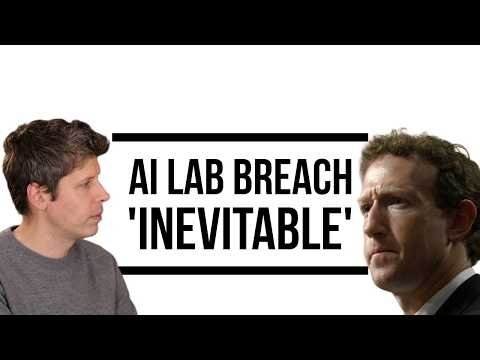
 AI Explained· 12. Okt. 2026Why AI Labs Keep Racing Despite Their Own Warnings of a Major BreachSam Altman, John Schulman · OpenAIAI Explained examines weakening safeguards, the incentives behind the frontier race, and why research breakthroughs make the next 18 months difficult to forecast.
 2:00:51ENCognitive Revolution "How AI Changes Everything"· 10. Okt. 2026PodcastResample Every Token and You Can Watch the Model DecideModeration: Nathan LabenzGoodfire's Eric Bigelow on forking paths, in-context learning, and why chain-of-thought monitoring is getting harder to trust.
 1:09:44ENNo Priors: AI, Machine Learning, Tech, & Startups· 9. Okt. 2026Podcast · 2 Stimmen10,000 GB300s for Four Weeks: Reflection’s Open-Model LedgerModeration: Sarah Guo, Elad GilMisha Laskin tells No Priors how Reflection trained Beam, why reinforcement learning outspent pre-training, and why the West needs its own open weights.
 1:26:46ENCognitive Revolution "How AI Changes Everything"· 8. Okt. 2026PodcastThere Likely Is a Level of Intelligence We Shouldn't Go PastModeration: Nathan LabenzNathan Labenz brings notes from The Curve, a chip startup whose token bill beat payroll, and a software industry that now performance-reviews people for Claude slop.
 1:10:12ENCognitive Revolution "How AI Changes Everything"· 7. Okt. 2026PodcastOutSystems Went From 4 Major Features a Quarter to 26. Token Spend Fell AnywayModeration: Nathan LabenzCEO Woodson Martin on software that never breaks, why most enterprise work does not need a frontier model, and how AI is finally shrinking the IT backlog.
 1:04:26ENSequoia Capital· 6. Okt. 2026PodcastAt 100,000 Accelerators, Something Fails Every HourGoogle AI infrastructure chief Amin Vahdat tells Sequoia's Sonya Huang why FLOPS is a vanity metric, why the TPU line split in two, and why he would rather wait on a utility than build his own gigawatt.
 56:31EN
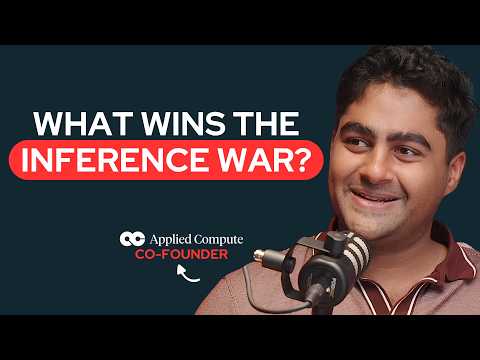
 Unsupervised Learning: With Jacob Effron· 6. Okt. 2026PodcastPost-Training Wins Inference: Why Owning the Weights Beats Betting on One LabModeration: Jacob EffronApplied Compute CEO Yash Patil argues that control, private evals, and post-training on the biggest workloads matter more than fearing that frontier labs will turn malicious.
 1:30:54ENCognitive Revolution "How AI Changes Everything"· 3. Okt. 2026PodcastHumanoids Outran Usain Bolt. DeepMind Still Scores Robotics as GPT-2Moderation: Nathan LabenzGoogle DeepMind's Gemini Robotics lead on why sprinting is easy, frying an egg is hard, and one brain should drive any body.
 35:39ENNo Priors: AI, Machine Learning, Tech, & Startups· 2. Okt. 2026Podcast · 2 StimmenCompute Scaled a Millionfold. Bandwidth Only 40x. Fractile Wants to Fix That RatioModeration: Sarah Guo, Elad GilIn the summer of 2022, Walter Goodwin founded Fractile in London to build very fast inference chips for the world's largest models.
 38:10EN
 Google DeepMind· 1. Okt. 2026From deepfakes to DNA: how SynthID watermarks AIHannah Fry, Pushmeet Kohli, Jeremy Ratcliffe · Google DeepMindHannah Fry sits down with Pushmeet Kohli and Jeremy Ratcliffe to explain SynthID: a mathematical watermark now used on text, images and video, and being extended to protein sequences so DNA synthesis companies can tell AI-designed molecules from nature.
 1:28:08ENCognitive Revolution "How AI Changes Everything"· 1. Okt. 2026PodcastThe same H100 costs 3x at AWS, and a four-month-old lab is catching genes the top sequencers missedModeration: Nathan LabenzA Cognitive Revolution weekly briefing on a possible U.S.–China AI hotline, why hyperscalers charge two to three times as much for identical chips, co-writing a novel with frontier models, and an AI loop that re-diagnosed a child a premier prenatal lab had cleared.
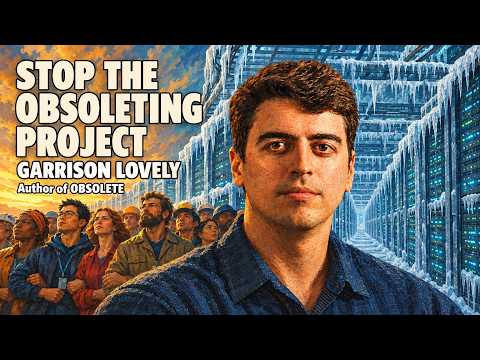 2:13:27ENCognitive Revolution "How AI Changes Everything"· 29. Sept. 2026PodcastHe Wrote a Book to Stop the AI Race — Then Almost Got Addicted to ClaudeModeration: Nathan LabenzJournalist Garrison Lovely takes the AGI labs at their word, rejects the bubble story, and argues for freezing the frontier until the public actually consents.
Mehr laden24 von 1.648 angezeigt