









Ergebnisse
152 ArtikelSortieren
 53:51EN
 Jane Street· 7. Okt. 2024Liora Friedberg on Solving Puzzles in ProductionYaron Minsky, Liora Friedberg · Jane StreetProduction engineering combines live incident response with software, process improvements and a culture that helps people learn from mistakes. Liora Friedberg and Ron Minsky explore the work at Jane Street.
 9:25ENJane Street· 1. Okt. 2024Richard Eisenberg: Using OCaml’s Coercion OperatorRichard Eisenberg · Jane StreetA practical tour of subtyping, polymorphic variants and private type abbreviations, with no runtime conversion cost.
 7:17ENJane Street· 13. Aug. 2024Erik and Martin Demaine on the Mathematics of Curved-Crease SculptureErik Demaine, Martin Demaine · MITThe MIT father-and-son collaborators turn paper folding into art and research, embedding puzzles and mathematical fonts in their sculpture Solve Me.
 8:06ENJane Street· 7. Aug. 2024How OCaml's Proposed Include Functor Syntax Reduces RepetitionRichard Eisenberg · Jane StreetA reverse-array example shows how to derive common module functions from a minimal implementation without an extra wrapper module.
 4:51ENJane Street· 2. Aug. 2024How Jane Street’s Creative Engagement Team Shapes Company CultureTala, Lana · Jane StreetTeam members describe how events, design and digital projects bring colleagues together and introduce the firm to new people.
 3:18ENJane Street· 1. Aug. 2024Rory on Production Engineering and Incident Support at Jane StreetRory · Jane StreetA production engineer describes monitoring order engines, responding to outages and building a supportive team.
 3:16ENJane Street· 18. Juli 2024JP on Machine Learning and Trading at Jane StreetJP · Jane StreetA Hong Kong equities trader describes his changing workday, the growth of research infrastructure, and the distinctive challenges of machine learning in finance.
 2:46ENJane Street· 18. Juli 2024Matt on Machine Learning and Trading at Jane StreetMatt · Jane StreetA Hong Kong equities trader describes the challenges of financial data, the firm’s ML roles and its collaborative culture.
 1:03:36ENJane Street· 12. Juli 2024Erin Murphy on Designing Tools for Expert UsersYaron Minsky, Erin Murphy · Jane StreetFrom NASA scientists to Jane Street engineers, a UX designer explains how observation, drawing and collaboration reveal what complex tools need to do.
 14:36ENJane Street· 24. Juni 2024Programming with OCaml's Local ModeRichard Eisenberg · Jane StreetAn example shows how a local list can contain global values, why a non-escaping annotation alone does not ensure stack allocation, and where the experimental feature remains awkward.
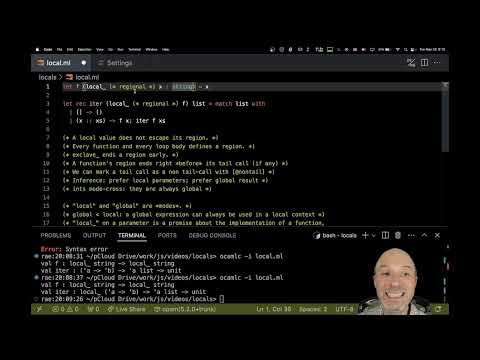 11:28ENJane Street· 13. Juni 2024OCaml Local Types: Regional Parameters and Loop RegionsRichard Eisenberg · Jane StreetA demonstration explains why some local parameters can cross a function boundary and how loop regions reclaim allocations.
 3:11ENJane Street· 31. Mai 2024Alok on Quantitative Research at Jane StreetAlok Puranik · Jane StreetA researcher describes projects, useful mathematical background and how candidates can prepare for interviews.
 9:14ENJane Street· 29. Mai 2024OCaml Local Function Types: Why Partial Application Can EscapeRichard Eisenberg · Jane StreetRichard Eisenberg uses a list-append example to show how a local argument changes the mode of a partially applied function in Jane Street’s OCaml compiler branch.
 15:59ENJane Street· 7. Mai 2024Tail Calls and Local Regions in OCamlRichard Eisenberg · Jane StreetA list-counting example reveals why a local closure can escape at a tail call, and how regional mode and [@nontail] affect the result.
 3:30ENJane Street· 13. März 2024Richard Eisenberg on Jane Street's OCaml ExperimentsRichard Eisenberg · Jane StreetJane Street's compiler team is exploring unboxed types, locality modes, and data-race-free parallelism to make OCaml's performance and memory management better suited to its needs.
 11:07ENJane Street· 29. Feb. 2024How OCaml Locals Use a Separate StackRichard Eisenberg · Jane StreetA list example shows how region-scoped local values can avoid repeated garbage-collected allocations.
 23:25ENJane Street· 20. Feb. 2024Richard Eisenberg: How OCaml Locals Reduce Garbage-Collected AllocationRichard Eisenberg · Jane StreetAn annotated list-processing example shows why locality must be preserved both when values are created and when functions consume them.
 22:27ENJane Street· 7. Feb. 2024How OCaml Infers LocalityRichard Eisenberg · Jane StreetA look at local and global mode inference, module signatures, mode crossing for integers, and conversions between function types.
 15:17ENJane Street· 31. Jan. 2024OCaml Locals, Modes, and SubmodingRichard Eisenberg · Jane StreetA worked explanation of how local and global modes control escaping values, and how those modes interact with function types.
 12:52ENJane Street· 23. Jan. 2024OCaml Local Variables, Return Values and RegionsRichard Eisenberg · Jane StreetA worked example shows how `local_` and `exclave_` let a function accept a local value and return a local structure in its caller's region.
 8:52ENJane Street· 5. Jan. 2024Introducing Local Parameters in OCamlRichard Eisenberg · Jane StreetA demonstration of how Jane Street's experimental local mode restricts escaping values and makes function interfaces easier to reason about.
 55:34ENJane Street· 29. Nov. 2023Andrew Hunter on Performance Engineering for Low-Latency SystemsYaron Minsky, Andrew Hunter · Jane StreetWhy small optimizations pay at hyperscale, why trading latency is harder to measure, and how profiling, tracing, language design and hardware fit together.
 1:02:17ENJane Street· 15. Aug. 2023Peter Bogart-Johnson on Product Management, Poetry and ListeningYaron Minsky, Peter Bogart-Johnson · Jane StreetA poet and program manager explains how to earn a team’s trust, preserve what works and coordinate change without separating engineers from their users.
 2:20ENJane Street· 3. Juli 2023Sean on Hospitality and Office Life at Jane StreetSean · Jane StreetA member of Jane Street's London hospitality team describes fresh food, teamwork and the office events that bring colleagues together.
Mehr laden24 von 152 angezeigt