









Ergebnisse
91 ArtikelSortieren
 9:25EN
 Jane Street· 1. Okt. 2024Richard Eisenberg: Using OCaml’s Coercion OperatorRichard Eisenberg · Jane StreetA practical tour of subtyping, polymorphic variants and private type abbreviations, with no runtime conversion cost.
 8:06ENJane Street· 7. Aug. 2024How OCaml's Proposed Include Functor Syntax Reduces RepetitionRichard Eisenberg · Jane StreetA reverse-array example shows how to derive common module functions from a minimal implementation without an extra wrapper module.
 1:03:36ENJane Street· 12. Juli 2024Erin Murphy on Designing Tools for Expert UsersYaron Minsky, Erin Murphy · Jane StreetFrom NASA scientists to Jane Street engineers, a UX designer explains how observation, drawing and collaboration reveal what complex tools need to do.
 14:36ENJane Street· 24. Juni 2024Programming with OCaml's Local ModeRichard Eisenberg · Jane StreetAn example shows how a local list can contain global values, why a non-escaping annotation alone does not ensure stack allocation, and where the experimental feature remains awkward.
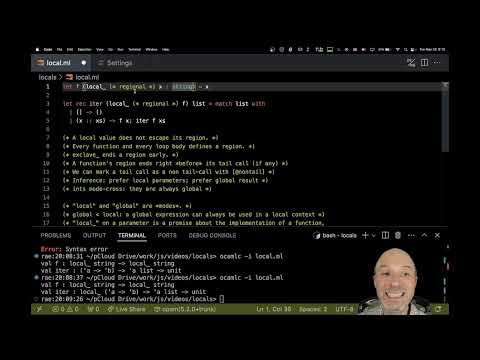 11:28ENJane Street· 13. Juni 2024OCaml Local Types: Regional Parameters and Loop RegionsRichard Eisenberg · Jane StreetA demonstration explains why some local parameters can cross a function boundary and how loop regions reclaim allocations.
 9:14ENJane Street· 29. Mai 2024OCaml Local Function Types: Why Partial Application Can EscapeRichard Eisenberg · Jane StreetRichard Eisenberg uses a list-append example to show how a local argument changes the mode of a partially applied function in Jane Street’s OCaml compiler branch.
 15:59ENJane Street· 7. Mai 2024Tail Calls and Local Regions in OCamlRichard Eisenberg · Jane StreetA list-counting example reveals why a local closure can escape at a tail call, and how regional mode and [@nontail] affect the result.
 3:30ENJane Street· 13. März 2024Richard Eisenberg on Jane Street's OCaml ExperimentsRichard Eisenberg · Jane StreetJane Street's compiler team is exploring unboxed types, locality modes, and data-race-free parallelism to make OCaml's performance and memory management better suited to its needs.
 11:07ENJane Street· 29. Feb. 2024How OCaml Locals Use a Separate StackRichard Eisenberg · Jane StreetA list example shows how region-scoped local values can avoid repeated garbage-collected allocations.
 23:25ENJane Street· 20. Feb. 2024Richard Eisenberg: How OCaml Locals Reduce Garbage-Collected AllocationRichard Eisenberg · Jane StreetAn annotated list-processing example shows why locality must be preserved both when values are created and when functions consume them.
 22:27ENJane Street· 7. Feb. 2024How OCaml Infers LocalityRichard Eisenberg · Jane StreetA look at local and global mode inference, module signatures, mode crossing for integers, and conversions between function types.
 15:17ENJane Street· 31. Jan. 2024OCaml Locals, Modes, and SubmodingRichard Eisenberg · Jane StreetA worked explanation of how local and global modes control escaping values, and how those modes interact with function types.
 12:52ENJane Street· 23. Jan. 2024OCaml Local Variables, Return Values and RegionsRichard Eisenberg · Jane StreetA worked example shows how `local_` and `exclave_` let a function accept a local value and return a local structure in its caller's region.
 8:52ENJane Street· 5. Jan. 2024Introducing Local Parameters in OCamlRichard Eisenberg · Jane StreetA demonstration of how Jane Street's experimental local mode restricts escaping values and makes function interfaces easier to reason about.
 55:34ENJane Street· 29. Nov. 2023Andrew Hunter on Performance Engineering for Low-Latency SystemsYaron Minsky, Andrew Hunter · Jane StreetWhy small optimizations pay at hyperscale, why trading latency is harder to measure, and how profiling, tracing, language design and hardware fit together.
 2:21ENJane Street· 30. Juni 2023Varun on Software Engineering at Jane StreetVarun · Jane StreetA London-based developer describes useful technical foundations, OCaml training and team matching at Jane Street.
 5:49ENJane Street· 23. Mai 2023Ian on Software Engineering at Jane StreetIan · Jane StreetA London desk developer explains code review, OCaml training, intern projects and the feedback that comes from sitting near users.
 59:38ENJane Street· 18. Mai 2023Richard Eisenberg on Dependent Types, OCaml, and AI-Assisted ProgrammingYaron Minsky, Richard Eisenberg · Jane StreetHow type systems can express correctness and performance, and why precise, readable specifications still matter when AI writes code.
 3:48ENJane Street· 10. Mai 2023Val on Software Engineering and Collaboration at Jane StreetVal · Jane StreetA London developer explains how colleagues teach new hires, review production code, and work across teams.
 3:30ENJane Street· 15. März 2023Brittany on Software Engineering and Internships at Jane StreetBrittany · Jane StreetAn equities desk engineer explains how interns learn finance and OCaml, contribute meaningful projects and collaborate with traders.
 3:09ENJane Street· 15. März 2023Minjie on Cybersecurity Engineering at Jane StreetMinjie · Jane StreetA Hong Kong software engineer describes learning OCaml, working on an internal permissions system and collaborating across teams on security alerts.
 37:24ENJane Street· 27. Feb. 2023Grace and Nolen's Software Engineering Mock InterviewGrace, Nolen · Jane StreetA unit-conversion graph illustrates how Jane Street interviewers discuss design, code, errors and communication with a candidate.
 4:11ENJane Street· 8. Nov. 2022Inside Production Engineering at Jane StreetMark, Liora Friedberg, Joseph · Jane StreetThree engineers describe the balance between resolving live issues and building software that makes support more effective.
 1:00:28ENJane Street· 12. Sept. 2022Ella Ehrlich on Modernizing a Critical Trading SystemYaron Minsky, Ella Ehrlich · Jane StreetJane Street’s Gord team rebuilt parts of a legacy data pipeline while preserving availability, and Ehrlich describes the recruiting programs she helped develop.
Mehr laden24 von 91 angezeigt